
Europe’s Generation of Protest
Author: Camilla Benvenuto
Editor: Adrian Diez Cuadrado
04/11/2026
14 minutes
“Governments should treat youth mobilisation as a source of political information rather than only a public-order problem.”
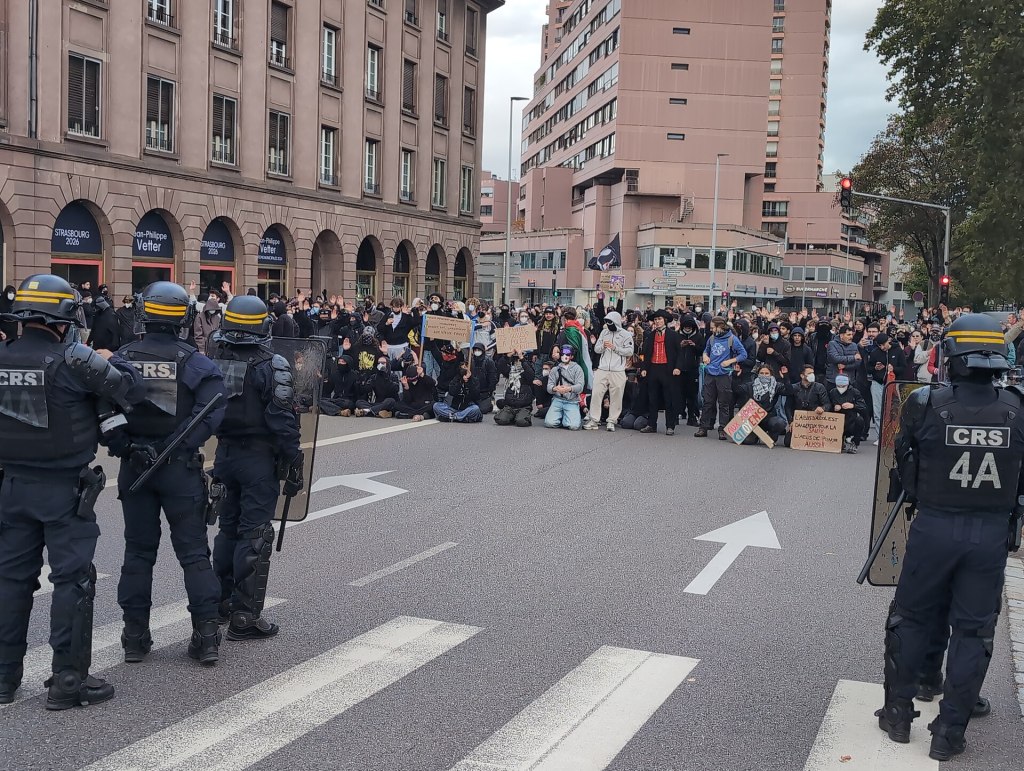
Manifestation du 24 octobre 2026 à Strasbourg © Akforwiki / Creative Commons Attribution-Share Alike 4.0 International License / Wikimedia Commons
Abstract
One year after Nepal’s September 2025 youth-led uprising drew attention to corruption, political privilege and generational frustration, student demonstrations and wider social protests across Europe have raised several questions; among these are economic opportunity, institutional responsiveness and democratic participation. From Serbia’s anti-corruption movement to protests concerning education in France and Belgium, younger generations are mobilising around different but overlapping grievances. Equally important is how these events are represented: Conventional news coverage may emphasise clashes and arrests, while footage circulated by participants may foreground peaceful assemblies, speeches and solidarity. This article examines the causes and political implications of youth mobilisation and the competing narratives through which protests acquire public legitimacy. It argues for examining both substantive grievances and the selective representation of protest, without assuming either journalism or participant-generated footage tells the complete story.
Background: From Nepal to Europe’s streets
In September 2025, Nepal’s youth-led protests attracted international attention as demonstrations against social-media restrictions became associated with wider grievances concerning corruption, nepotism and political exclusion. The events showed how an immediate trigger can expose accumulated dissatisfaction with the distribution of opportunities and the legitimacy of governing institutions. One year later, demonstrations across Europe raise related questions. The European cases are not direct extensions of Nepal’s mobilisation, but they provide a comparative opportunity to examine how grievances develop into collective action and how such movements are represented in public discourse.
By October 2026, student and youth participation was prominent in several European countries. French secondary-school students mobilised around educational conditions; Belgian students protested reforms and costs; and Serbian student activists sustained demands for institutional accountability. In Southern Europe, broader housing and cost-of-living demonstrations intersected with concerns of younger generations. The Associated Press linked wider unrest across European countries to economic insecurity and dissatisfaction with public institutions, although these demonstrations involved different constituencies and should not all be described as exclusively youth-led.
The European Students’ Union (ESU) recorded 54 student protest actions across 22 countries in the European Higher Education Area between 16 March and 16 May 2026, compared with 31 actions across 13 countries in its preceding monitoring period. Its cumulative monitoring documented 106 actions across 32 countries between September 2025 and May 2026. These figures describe recorded protest actions rather than a census of all demonstrations. They nevertheless indicate the breadth of student mobilisation and the overlap between educational concerns, living conditions, democratic accountability and civic freedoms.
Economic insecurity and changing expectations
Economic insecurity is an important dimension of youth mobilisation, but it is neither universal nor sufficient as an explanation. Young Europeans face varying combinations of high housing costs, insecure employment, education expenses and delayed financial independence. Such pressures can acquire political significance when educational achievement no longer appears to guarantee a stable livelihood. Yet the experiences of students, young employees and those outside education and work differ, as do the welfare institutions and housing markets of individual countries.
Eurostat reported that 11.0% of EU residents aged 15–29 were neither employed nor participating in education or training in 2025, down from 15.2% in 2015. Country differences remained substantial: the Netherlands recorded 5.3%, compared with Romania’s 19.2%. The improvement in this indicator cautions against presenting youth economic conditions as uniformly deteriorating. Aggregate gains can coexist with difficulties entering particular occupations, obtaining affordable housing and achieving independent living.
Housing affordability provides a useful illustration. In Italy, Spain and Portugal, concerns about rent, housing access and living costs feature in broader public debate and mobilisation. Le Monde situated demonstrations across several European countries within pressures involving housing, energy prices and public spending. The analytical question is not whether material hardship automatically causes protest, but how perceived unfairness, organised networks and political opportunities translate frustration into collective action.
From student demands to political movements
Serbia offers a particularly important case. The movement emerged following the November 2024 collapse of a railway-station canopy in Novi Sad, which killed 16 people. The disaster generated allegations of corruption, negligence and inadequate public oversight. Student activists organised demonstrations and university blockades demanding accountability, attracting wider participation from citizens concerned about governance. The movement’s assemblies and decentralised organisation distinguished its initial approach from conventional party politics, although sustained mobilisation subsequently raised questions about electoral participation and institutional influence.
The Serbian media environment is itself part of the story. The Reuters Institute’s Digital News Report 2026 describes political pressures on independent journalism and the use of politically aligned outlets to discredit dissenting voices. This makes Serbia an important case for examining how media ownership and political power shape the perceived legitimacy of protest. The issue is not only what protesters demand, but whose interpretation reaches the public.
France presents a different trajectory. During September and October 2026, high-school students organised blockades and demonstrations over teacher shortages, overcrowded classrooms and deteriorating facilities. National reporting by Le Monde documented peaceful marches and political discussions as well as serious episodes of vandalism, clashes and police interventions. The coexistence of peaceful mobilisation and confrontations is central to understanding why the character of an entire movement cannot be inferred from its most dramatic incidents.
In French-speaking Belgium, students mobilised against education reforms and associated costs. Reporting distinguished peaceful demonstrations in Brussels from incidents in Liège, while later Reuters coverage documented confrontations with police during an October demonstration. These cases show why geography, date and chronology matter: different gatherings within the same movement can unfold very differently. They also demonstrate how education policy becomes a site for broader debate about public priorities and institutional responsiveness.
Beyond the headlines: Violence and peaceful mobilisation
One of the most revealing dimensions of recent youth protests is the contrast between the way demonstrations are experienced by participants and the way they are sometimes represented publicly. Headlines and television reports may emphasise arrests, fires, property damage and riot police. By contrast, videos circulated by demonstrators may show peaceful marches, student assemblies, collective singing and speeches. These representations can produce very different impressions of the same movement even when each contains factual information.
Media studies describe a recurring “protest paradigm” in which coverage can foreground confrontation, disruption, official sources and spectacle rather than protesters’ substantive demands. This does not mean journalists should ignore violence or that reporting on disorder is necessarily misleading. It means editorial decisions about headlines, photographs, quoted sources and narrative sequence influence what audiences understand as the defining features of an event.
The French case illustrates the issue. Le Monde (2 October 2026) reported concerns about disorder and police interventions while also documenting questions about injuries and proportionality. Its subsequent reporting described predominantly peaceful or festive marches before clashes occurred towards the end of some demonstrations. Another account distinguished the peaceful character of many school blockades from serious violence affecting a smaller number of institutions. The relevant distinction is between a movement’s overall participation and specific incidents for which particular individuals may be responsible.
Italy offers a further question about geographic selectivity in protest coverage. Reports of confrontations or disruption associated with demonstrations in Milan can produce a highly visible narrative of disorder, while peaceful student mobilisation in Southern Italy may be less prominent in national news agendas. Yet the available examples do not establish that newspapers covered only violence in Milan or ignored peaceful protests in the South. Indeed, la Repubblica and Corriere della Sera reported on students’ tent encampments in Naples, detailing their demands for affordable housing, university dining facilities, scholarships and public investment. Those reports are important counterexamples to any categorical claim of silence.
The sharper question is one of prominence and reach: do images of confrontation in a northern metropolis travel further across national headlines, television bulletins and social feeds than peaceful assemblies in Naples and other southern cities? La Repubblica also documented student housing protests in Milan and Rome and school mobilisations in multiple cities, including Naples, showing that protest activity cannot be reduced to a North-versus-South contrast. To test a geographic double standard, a systematic comparison should count articles and broadcast segments by city, record headline language and lead photographs, distinguish peaceful events from violent incidents and compare equivalent dates and protest sizes. Without that evidence, uneven visibility is a plausible research question, not a demonstrated editorial practice.
This Italian comparison matters for the broader argument because an isolated violent episode can become shorthand for a movement while sustained, peaceful organising remains less visible. The analytical task is not to excuse violence or idealise online footage, but to ask whose participation becomes nationally legible, how geographic location shapes newsworthiness and whether protest demands survive the competition for attention.
Participant-generated social media footage can challenge a narrow focus on confrontation by showing aspects of protests otherwise overlooked. However, it is not inherently more accurate. A short clip of a peaceful crowd cannot prove that violence did not occur elsewhere, just as footage of a burning vehicle cannot show that all participants engaged in violence. Reliable interpretation requires verification of time, place, sequence, the size of the gathering and the relationship of those involved to the wider movement.
Media framing also affects political legitimacy. If public debate focuses primarily on disorder, protesters’ original demands may receive less attention and official responses may be debated mainly as security measures. Conversely, idealised depictions of peaceful mobilisation may minimise genuine harm to residents, public employees, demonstrators or police. The goal should not be to replace one selective narrative with another, but to account for both the political claims of participants and the conduct of particular actors.
Italy: Geographic and occupational inequalities in protest visibility
The Italian case makes it possible to test a more specific claim about unequal visibility. In Milan, Corriere della Sera’s 17 October headline foregrounded stones thrown at police during a demonstration about fuel prices and low wages. A separate article characterised participants through youth, disorder and confrontation. These are legitimate news subjects, given the reported damage and attacks, but they also show how conflict can become the defining angle of an event.
Meanwhile, Naples saw student tent encampments at Federico II University focused on rents, student housing and the cost of education. La Repubblica documented their policy demands on 13–14 October; Rai TGR Campania reported school occupations on 12 October, including students’ statements that one occupation occurred without assaults or pushing of school staff. Corriere del Mezzogiorno also covered a sit-in and university occupation on 19 October. Southern protests were therefore not ignored altogether: the demonstrable difference in this small sample is that Naples reporting foregrounded grievances and local mobilisation, while the selected Milan reports foregrounded clashes.
Crucially, these are not identical demonstrations: the Milan event concerned fuel costs and wages, while Naples mobilisations centred on education and housing. The two cases show different editorial emphases, but two cities are too small a sample to reveal a national North–South pattern. A stronger test would count national-front-page placement, article frequency, word count, visual selection and treatment of demands across matched dates, using the same newspapers and comparable protest types. National wire service ANSA, moreover, reported nationwide student demonstrations including Naples and described clashes in other cities, showing that peaceful southern participation did enter national coverage.
The question of selective visibility extends beyond university students and beyond a Milan–Naples contrast. In October 2026, farmers and road-haulage workers organised sustained protests across Calabria and Campania over diesel prices and production costs. These were not merely isolated incidents: ANSA documented tractor and lorry presences around Castrovillari and the Sibari plain on 13 October, road-haulage demonstrations around motorway junctions near Naples and Caserta on 16 October and continuing actions in Calabria on 18 October. The reports show a substantial regional mobilisation; how much of it reached national television bulletins or front pages is less clear.
These demonstrations are especially revealing because some were explicitly peaceful. On 17 October, ANSA described a peaceful procession of students, residents and farmers in Corigliano-Rossano, with tractors leading the march. The preceding day, it had reported secondary-school students joining an agricultural protest in the same area. Such participation complicates any sharp division between “youth protests” and occupational protests: students were mobilising alongside workers around shared concerns about local economic survival.
The protests were not universally free of disruption: ANSA reported that farmers blocked the approach to Lamezia Terme airport on 7 October, and truck demonstrations caused traffic difficulties near motorway junctions. A fair comparison must therefore avoid portraying all southern demonstrations as entirely peaceful. The analytically important question is whether a disruption in one location receives national prominence while similarly significant, sustained or peaceful mobilisations elsewhere remain confined to regional news pages. Existing reporting establishes that these movements occurred and that peaceful participation was documented. Establishing such a double standard would require a defined sample of national front pages, television bulletins and regional reports, coded by event date, region, sector, estimated participation, disruption and headline emphasis.
The broader argument is consequently about both the framing of visible protests and the agenda-setting process that determines which protests become visible at all. The juxtaposition of dramatic scenes in Milan with the less nationally prominent, often sustained actions of farmers and hauliers in Southern Italy is a testable question about geography, occupation and the news value assigned to conflict. Nor is this a story of silence, since ANSA reported these events, including on its national economy pages. What the evidence does justify is asking whether editorial attention systematically privileges spectacular confrontation over peaceful or economically focused mobilisation.
Framing, agenda-setting and the limits of online counter-narratives
Two established concepts clarify this issue. Framing concerns how selecting and emphasising aspects of an event shapes the problem readers perceive, its presumed causes and possible remedies. Agenda-setting concerns which issues receive sufficient attention to become publicly salient. In the Italian comparison, the first question is whether Milan is presented principally as violence while Naples is presented as a housing grievance; the second is whether the former receives more prominent and repeated national attention. These are distinct empirical questions.
Online video can challenge an impression created by conflict-centred headlines by showing marches, assemblies and speeches. Yet neither participant footage nor news imagery establishes the character of a whole protest on its own. To compare them rigorously, researchers should verify the original uploader, date, location, full sequence and what occurred before and after the clip. The current article does not claim to have authenticated a matched collection of social-media videos; the proposed comparison is a research method, not a completed finding.
Attribution: violence by whom?
Reporting should distinguish peaceful participants, individuals who damaged property or assaulted others, counterdemonstrators where present and police use of force. A confrontation at the end of a march does not establish that the whole crowd participated; conversely, evidence of peaceful assembly does not negate documented injuries or damage. In Naples, la Repubblica reported disagreement between a school principal’s description of a forceful occupation and students’ account denying violence. Such contested claims should be attributed, not converted into settled conclusions.
Comparing Nepal and Europe without assuming equivalence
The comparison with Nepal is most useful as a set of questions: what immediate event triggered mobilisation; which longer-standing grievances did participants identify; when did public discussion shift towards policing and disorder; and how did participant-produced material differ from published news accounts? Political institutions and protest conditions differ substantially, so similar visual narratives should not be treated as proof of identical causes or consequences. The comparison should use same-day reporting and independently verified footage for each country before drawing conclusions about unequal treatment.
Comparing national, international and online narratives
A rigorous comparison should examine the same demonstration, on the same date and in the same location, across a national newspaper, an international news outlet and verified participant footage. It should assess the prominence of protest demands, the use of police or government sources, the treatment of violence, image selection and whether reporting distinguishes the wider gathering from isolated incidents. Differences in framing should be demonstrated rather than presumed.
In France, Le Monde reported both peaceful student political engagement and episodes of confrontation. International coverage also documented the unrest and public-order implications. In Belgium, accounts differed partly because demonstrations in Brussels and Liège did not unfold identically. In Serbia, the Reuters Institute’s analysis of the media environment indicates why editorial independence must be considered when comparing narratives.
This approach provides a direct link with Nepal’s September 2025 demonstrations. A comparative study could ask whether international headlines foregrounded the social-media ban and violent episodes more than the underlying grievances concerning political privilege and corruption. It could then test whether comparable editorial patterns appear in European coverage. Any differences might also come down to distinct events, unequal access to sources or ordinary editorial judgement.
Democratic participation and institutional legitimacy
Youth demonstrations are sometimes read as signs of declining political trust. Yet protest can also be a form of democratic engagement: citizens may mobilise because they expect institutions to meet standards of accountability, fairness and responsiveness. Serbia’s student demands for transparency and the French and Belgian calls for improved educational provision can be understood as efforts to influence public institutions, not necessarily to reject democratic government.
The response to a protest can itself become a new source of grievance. When participants perceive official action as dismissive or disproportionate, disputes may expand from education or economic policy to civil liberties and institutional legitimacy. Conversely, violence against people or property can create legitimate demands for protection and accountability. Democratic institutions must address both realities while distinguishing peaceful participants from individuals responsible for unlawful acts.
Digital communication complicates this relationship by accelerating mobilisation and spreading competing narratives. It can widen participation, but it can also circulate edited or misleading accounts. Independent reporting, transparent official communication and media literacy are therefore complementary democratic needs rather than substitutes for one another.
Policy implications
Governments should treat youth mobilisation as a source of political information rather than only a public-order problem. Protecting safety is essential, but an exclusively security-oriented response may leave the causes of dissatisfaction untouched. Meaningful youth councils, student representation, public consultation and participatory budgeting can improve responsiveness if participants have genuine opportunities to influence decisions and receive clear explanations of outcomes.
Economic policy should address national differences in housing affordability, education financing, employment insecurity and access to services. EU-wide averages can help identify broad pressures, but they should not obscure differences between national labour markets and welfare systems. Governments should also strengthen transparency and independent oversight where protesters raise allegations of corruption or inadequate public accountability.
Police responses should protect peaceful assembly while responding proportionately to violence. Investigations into alleged misconduct, accurate public information and clear distinctions between peaceful participants and those involved in unlawful acts can help maintain public confidence. Journalists and researchers, meanwhile, should document protesters’ demands alongside incidents of confrontation and avoid presenting isolated imagery as representative of entire movements.
Finally, comparative monitoring of youth protests could combine institutional socioeconomic indicators with independently collected evidence on protest demands, organisation and government responses. Media-framing research should compare equivalent events across national, international and social-media sources, rather than drawing conclusions from a small number of dramatic headlines.
Conclusion: Who gets to define a generation’s protest?
One year after Nepal’s youth-led demonstrations, European protests highlight the continuing importance of younger generations in debates about opportunity, institutional accountability and democratic representation. The movements are not homogeneous: some concern education and economic conditions, while others challenge broader systems of governance. Treating them as a single generational uprising would obscure these differences.
A common concern nevertheless emerges: the relationship between what protesters seek to communicate and what the wider public understands about their actions. Coverage emphasising violence may obscure peaceful participation and political demands; selectively shared footage may understate serious confrontations. Both must be evaluated critically. The future of democratic participation depends not on the absence of disagreement, but on whether institutions can accommodate dissent, respond to grievances and distinguish peaceful political engagement from violence without allowing either to define an entire movement.
Disclaimer: The views and opinions expressed in this article are those of the author(s) and do not necessarily reflect the official position of the Neo Institute Europa. The Neo Institute publishes contributions to foster informed public debate. While articles may be reviewed and edited, the author(s) remain solely responsible for the claims, interpretations and conclusions expressed. This content is provided for informational purposes. The Neo Institute Europa shall not be liable for any loss or damage arising from reliance on this article.


