
“Kim Il-sung’s personal revolutionary credentials could not literally be inherited, but the mythology constructed around them could.”
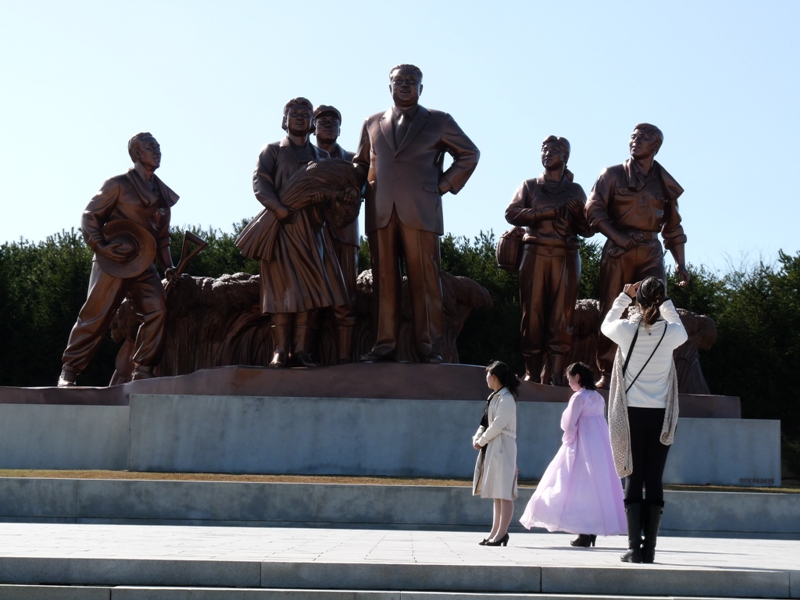
Kim Il-sung bronze statue © ellsworth / Creative Commons Attribution 4.0 International License / Free for use / Wikimedia Commons
Kim Il-sung died in 1994, after almost half a century at the centre of North Korean political life. More than three decades later, however, his presence has hardly disappeared from the Democratic People’s Republic of Korea. His image remains embedded in the country’s political landscape, his legacy continues to be invoked by the regime, and the personality cult constructed around him has survived through two generations of dynastic succession. Even in death, Kim remains inseparable from the symbolic foundations of the North Korean state.
This longevity raises a broader question about the nature of political charisma. Charismatic authority is often associated with the exceptional qualities of an individual leader and with the emotional relationship established between that leader and their followers, yet Kim Il-sung’s case suggests that charisma can become something more durable: A political resource constructed through revolutionary legitimacy, national mythology and control over public representation. Kim’s transformation from anti-Japanese guerrilla fighter into the “Great Leader” and symbolic father of the nation followed a pattern that had characterised charismatic revolutionary leaders long before the twentieth century.
Kim Il-sung’s rise took place against the backdrop of one of the most turbulent periods in modern Korean history. Between 1910 and 1945, Korea was subjected to Japanese colonial rule, and resistance to Japanese occupation became an important source of political legitimacy for the leaders who emerged after liberation. Kim, who participated in anti-Japanese guerrilla activities in Manchuria, was among the political figures who emerged in northern Korea after the end of the Second World War. In 1948, at the age of 36, he became premier of the newly established Democratic People’s Republic of Korea. His political ascent, however, cannot be understood solely through the military lens. North Korean narratives progressively elevated Kim’s participation in the anti-Japanese struggle into a politically exceptional revolutionary achievement. Official accounts magnified his role while diminishing those of other resistance figures, presenting his leadership as decisive to Korea’s liberation. Hence, the guerrilla fighter was gradually transformed into the central protagonist of a national founding narrative. This transformation closely reflects the pattern associated with charismatic revolutionary leadership.
Kim’s image combined military legitimacy with the experience of national crisis and the creation of a new political order. Decades of colonial domination, the upheaval following Japan’s defeat, and the subsequent division of the Korean Peninsula created an environment in which revolutionary credentials carried extraordinary political significance. Within the emerging North Korean narrative, Kim was therefore not simply one political leader among others; he increasingly appeared as the single figure capable of leading the Korean people from foreign domination towards national rebirth. The construction of this image also drew on narratives that resonated with existing Korean cultural traditions: Scholars have identified parallels between official representations of Kim and older Korean foundation myths, in which an extraordinary figure emerges after a period of suffering to establish a new order. Through this political mythology, Kim’s revolutionary biography acquired an almost sacred dimension. His authority could consequently be represented not merely as the outcome of political circumstances, but as the culmination of a historical mission. Revolutionary credentials alone could not sustain charismatic authority indefinitely, and therefore Kim Il-sung’s leadership came to rely on an increasingly elaborate personality cult that represents the leader as both extraordinary and intimately connected to the lives of ordinary North Koreans.
Propaganda played a central role in this transformation. Official biographies, newspapers, education and other forms of political communication progressively constructed an idealised account of Kim’s life, magnifying his revolutionary achievements and presenting him as an almost infallible protagonist of modern Korean history. His anti-Japanese struggle developed into a foundational narrative in which the history of the leader and that of the nation increasingly overlapped. Yet the effectiveness of this representation depended on an apparent contradiction. Kim had to remain sufficiently extraordinary to command reverence, while appearing sufficiently close to ordinary citizens to inspire personal attachment. His highly publicised visits to factories, farms, schools and military units helped reconcile these two dimensions. Through the practice of “on-the-spot guidance”, the leader was repeatedly depicted among workers, farmers, soldiers and children, listening, observing and providing direction. Such encounters served practical and political purposes, but their representation also reinforced the image of a paternal leader personally involved in the everyday life of the nation. Similarly, the vocabulary surrounding Kim reflected the same dynamic; titles and representations showcasing him as the “Great Leader”, as the father of socialist Korea and the “sun” of the nation placed him above ordinary political authority. At the same time, paternal imagery framed the relationship between ruler and population through the familiar language of family and care. Political obedience could thus be represented as loyalty to a government but also as the emotional bond between the population and the symbolic father of the nation.
Kim Il-sung’s charisma was therefore simultaneously personal and constructed, as his historical biography provided the raw material but propaganda and control over collective memory transformed that biography into something larger: A political myth in which loyalty to the leader became increasingly difficult to separate from loyalty to the state itself. However, the ultimate test of charismatic authority comes when the charismatic leader disappears, and, because charisma is rooted in the perceived exceptional qualities of an individual, the leader’s death creates a fundamental problem of succession. In Weberian terms, charisma must somehow be transformed or institutionalised if the political order built around it is to survive. Kim Il-sung’s death in 1994 therefore presented the North Korean regime with a paradox: the state had spent decades identifying its revolutionary legitimacy with one individual, yet now had to preserve that system without him. The solution to the problem was remarkable. The 1998 constitutional revision abolished the office of President while its preamble enshrined Kim Il-sung as the “eternal President of the Republic”; this way, his son Kim Jong-il consequently ruled through other party and state positions without formally succeeding his father as President.
The significance of this choice went beyond symbolism, as by keeping Kim Il-sung at the centre of the state’s foundational narrative, the regime could anchor the legitimacy of subsequent leaders in their relationship with him, and the personality cult developed around one revolutionary leader gradually became a dynastic political institution. Kim Jong-il helped consolidate this system, while the later succession of Kim Jong-un demonstrated its ability to survive another generational transition. The North Korean case therefore complicates the idea that charisma necessarily disappears with the charismatic individual. Kim Il-sung’s personal revolutionary credentials could not literally be inherited, but the mythology constructed around them could. Through political institutions, propaganda, ritual and dynastic succession, the founder’s charisma became embedded in the structures through which political legitimacy was reproduced: More than three decades after his death, Kim Il-sung consequently remains central to North Korea’s political identity.
 Neo Institute Europa