
Producing Loss: Luxury Safari Tourism and the Postcolonial Political Ecology of the Maasai Mara
Author: Camilla Benvenuto
Editor: Emilio Guzmán
17/06/2026
7 minutes
“Environmental degradation is […] not external to conservation, but integral to its operation. Loss is produced through economic transformation and monetised within global markets, governed through institutional frameworks, recognised as damage, yet insufficiently addressed and compensated.”
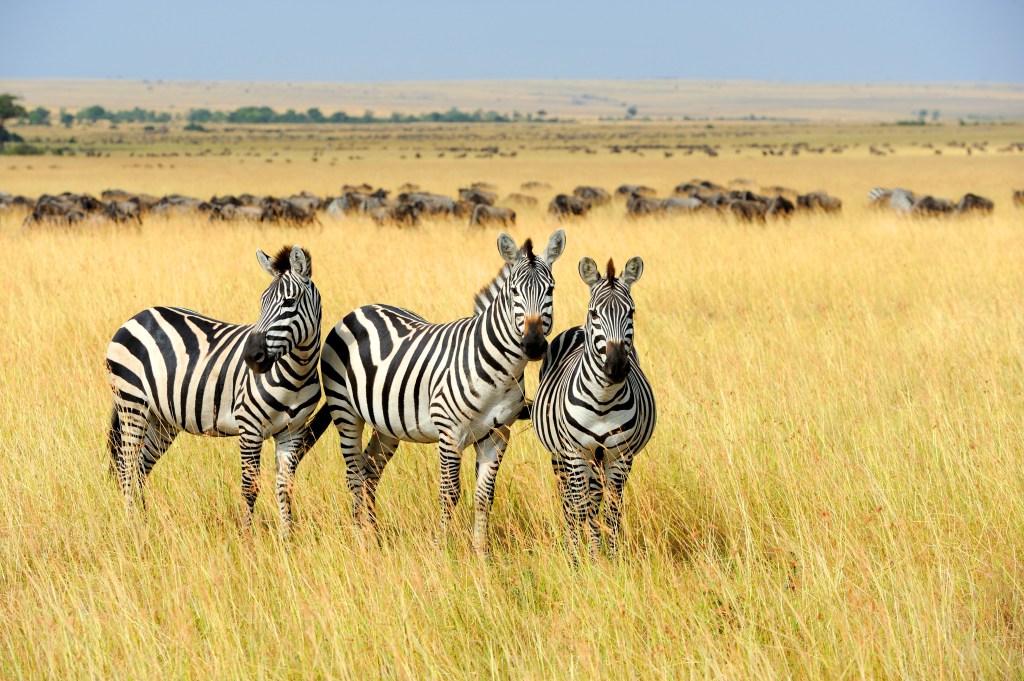
Three zebras in Masai Mara National Park, Kenya © Volodymyr Burdiak / Creative Commons Attribution 4.0 International License / Free for use / Wikimedia Commons
The Maasai Mara National Reserve in Kenya, plays a crucial part in the Great Migration, the annual movement of more than 1.5 million wildebeest, zebras and gazelles between the Serengeti National Park in Tanzania and the Maasai Mara National Reserve in search of fresh grazing land and water. The Great Migration is considered the largest land-animal migration in the world, being one of the world’s most important ecological processes. As the herds move, they spread nutrients through grazing and manure, support predator populations such as lions and crocodiles, contribute to biodiversity across the region and the overall balance of the East African savanna ecosystem.
The opening of a Ritz-Carlton–affiliated high-end safari camp in 2025, in Kenya’s Maasai Mara and the subsequent legal challenges brought by Maasai activists, have drawn attention to a persistent tension: Can tourism-led conservation sustain the ecological systems upon which it depends? The expansion of high-end safari tourism has thus generated renewed debate over the relationship between conservation, capital accumulation and ecological change.
This article argues that the controversy cannot be understood solely in terms of regulatory failure or site-specific environmental impact. Rather, it reflects a broader political-economic formation in which environmental degradation and conservation are co-produced. Drawing on postcolonial political ecology and socio-legal theory, it develops a tripartite conceptual framework; the governance of loss, the economic of loss and the framework of loss and damage.
Together, these concepts illuminate how ecological fragility is not only produced and managed, but also valorised. The Maasai Mara case suggests that luxury safari tourism reorganizes ecological processes, land relations and value extraction in ways that render loss simultaneously governable, economically productive and politically contested.
Political Ecology, Postcoloniality and the Governance of Loss
Political ecology has long emphasised that environmental change is inseparable from relations of power, capital and knowledge. Conservation has been conceptualised as a process of accumulation by dispossession, while more recent scholarship situates environmental transformation within the broader reorganisation of nature under capitalism. Postcolonial political ecology further demonstrates how conservation in Africa reproduces colonial patterns of territorial control while incorporating neoliberal governance mechanisms. Conservation landscapes often function as forms of green enclosure, reterritorialising land for global capital while restructuring local livelihoods. Recent socio-legal scholarship introduces a complementary perspective by conceptualising loss as a central object of governance. Giacomo Tagiuri develops the notion of governance of loss to describe how legal and institutional frameworks anticipate and manage the consequences of economic transformation. These processes generate not only economic but also social, cultural and political loss.
This perspective resonates with the international framework of loss and damage developed under the United Nations Framework Convention on Climate Change (UNFCCC), which addresses irreversible harms resulting from environmental change. While it was originally formulated in the context of climate impacts, loss and damage provides a broader lens through which to understand how environmental harm is recognised, distributed and contested.
In the Maasai Mara, the expansion of safari tourism produces multiple forms of loss:
- Ecological loss (fragmentation of animal migration routes)
- Spatial loss (enclosure of rangelands)
- Livelihood loss (constraints on pastoral mobility)
- Political and cultural loss (reconfiguration of land authority)
These losses are not external to conservation systems. They are structured through environmental impact assessments, zoning regulations and conservancy agreements, which define acceptable thresholds of degradation. Governance thus operates through calibration rather than prevention, producing a condition of managed ecological instability.
From the perspective of loss and damage, this raises a critical question: When does calibrated degradation become irreversible harm?
The Economy of Loss
If governance of loss structures how degradation is managed, the economy of loss explains how it is valorised.
Political ecology has increasingly recognised that capitalism generates value through ecological degradation. As Anna Tsing argues, accumulation often proceeds through “salvage accumulation”, extracting value from damaged or precarious environments. Similarly, Neil Smith’s work on uneven development shows how environmental transformation creates new opportunities for capital investment. Another aspect examined by recent scholars is the concept of green sacrifice zones, which challenges the logic of sacrifice by advocating a conceptual shift: Instead of treating local territories as expendable in the pursuit of global objectives, it reconceives them as vital elements of Earth’s interconnected ecosystem, where global governance may need to exercise restraint in order to safeguard specific ecological and cultural systems.
In conservation contexts, scarcity itself becomes a commodity, particularly within high-end tourism markets. The increasing rarity of intact ecosystems enhances their exchange value, especially for elite consumers seeking exclusive experiences.
The economy of loss is characterised by three dynamics:
- Scarcity as value: Ecological rarity increases exchange value
- Managed degradation: Environmental change is regulated to sustain value
- Temporalisation of crisis: The perception of imminent loss accelerates demand
Using this logic, the Great Migration thus becomes a temporalized ecological spectacle, whose economic value depends on its perceived vulnerability. The migration is also economically significant, attracting millions of tourists each year, which has brought funds to support conservation efforts and local communities.
The framework of loss and damage sharpens this analysis. While loss and damage emphasises the need to recognise and compensate for irreversible harm, the economy of loss reveals a paradox: The same processes that generate irreversible ecological loss can simultaneously produce economic value.
In the Maasai Mara, the fragmentation of migration routes may constitute ecological damage that cannot be reversed. Yet this increasing fragility enhances the scarcity, and thus the market value, of the migration as a tourist attraction.
Historical Precedents: Fragmentation, Mobility, and Managed Decline
Empirical evidence from East African rangelands demonstrates that the disruption of migratory systems is cumulative and historically embedded. In the Tarangire ecosystem (Tanzania), agricultural expansion progressively blocked wildlife corridors, leading to the decline of seasonal migrations. In Kenya’s Loita Plains, wildebeest populations collapsed from approximately 140,000 to fewer than 15,000 due to fencing and land subdivision. Across the Serengeti–Mara system, human activity has altered migration timing and spatial distribution, reflecting processes of progressive ecological destabilisation. Research shows that fencing in the Greater Mara threatens rapid ecosystem collapse by fragmenting habitats and restricting mobility. At the same time, conservation models such as the Grumeti Reserve demonstrate how migration can be preserved within privatised and highly regulated landscapes oriented toward elite tourism. Conservation models such as the Grumeti Reserve attempt to preserve migration routes through privatised protected areas funded by luxury tourism and strict wildlife management. While these projects do support conservation and create local employment, they are also controversial because some communities face restrictions on land use, grazing and access to natural resources. As a result, conservation in East Africa is often debated as both an ecological and social issue.
Within the Maasai Mara, the expansion of conservancies further embeds ecological processes within market relations, reshaping land use and mobility. Taken together, these cases show that migration systems are not simply threatened but reconfigured through cumulative processes of enclosure, infrastructure and commodification.
The transformation of the Maasai Mara reflects broader shifts in land relations. Historically, Maasai pastoralism relied on flexible mobility compatible with wildlife migration. Colonial and postcolonial interventions introduced fixed boundaries and new property regimes that restructured access to land. Contemporary conservation intensifies these dynamics through market-based arrangements that prioritise exchange value over subsistence use.
From the perspective of governance of loss, these transformations reorganise not only material conditions but also the distribution of authority, embedding local communities within systems that manage, but do not eliminate, their losses. The discourse of sustainability plays a central role in legitimising luxury safari tourism. However, this framing obscures the cumulative effects of infrastructural expansion and land-use change.
Critical scholarship shows that sustainability often functions as a mechanism for managing, rather than resolving, ecological contradictions. Within a governance of loss framework, sustainability defines acceptable thresholds of disruption, enabling continued accumulation while maintaining the appearance of environmental responsibility.
Conservation Between Governance and Accumulation
The Maasai Mara exemplifies a system in which ecological processes are simultaneously:
- Increasingly threatened by economic development and land transformation
- Governed through legal and institutional frameworks
- Valorised within global tourism markets
Migration persists within conditions of controlled ecological precarity, sustained precisely through its ongoing transformation. The controversy surrounding the Ritz-Carlton safari camp reveals not a failure of conservation, but its contemporary logic. The Maasai Mara is shaped by a governance regime that normalises ecological loss while enabling its commodification. The concepts of governance of loss, economy of loss and loss and damage together illuminate this dynamic. Governance systems make ecological loss easier to recognise and regulate, economic activities can turn it into profit and the idea of loss and damage emphasises that these changes are often permanent and unfair.
Environmental degradation is therefore not external to conservation, but integral to its operation. Loss is produced through economic transformation and monetised within global markets, governed through institutional frameworks, recognised as damage, yet insufficiently addressed and compensated. What appears as an ecological crisis is therefore not simply a breakdown of conservation, but a condition of its possibility, one in which loss is simultaneously governed and made productive for the benefit of the national and global elites.
Disclaimer: The views and opinions expressed in this article are those of the author(s) and do not necessarily reflect the official position of the Neo Institute Europa. The Neo Institute publishes contributions to foster informed public debate. While articles may be reviewed and edited, the author(s) remain solely responsible for the claims, interpretations and conclusions expressed. This content is provided for informational purposes. The Neo Institute Europa shall not be liable for any loss or damage arising from reliance on this article.

