
Named by the Adversary: Europe’s Security Gap and the Defence Executive
Author: Tom Scheer
Editor: Javier Sutil Toledano
27/05/2026
5 minutes
“The adversary has identified an undefended target category. European institutions have done neither.”
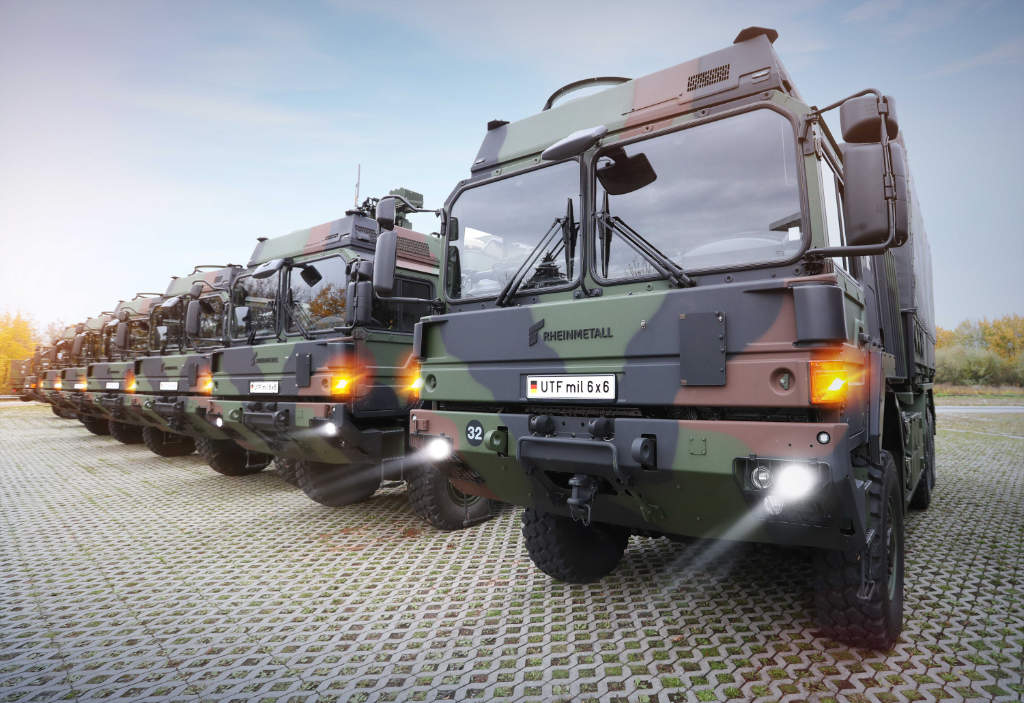
Military trucks from Rheinmetall © Rheinmetall AG / Creative Commons Attribution 4.0 International License / Free for use / Wikimedia Commons
In July 2024, US intelligence disrupted a Russian plot to assassinate Armin Papperger, CEO of Rheinmetall. The plot, apparently, was a direct response to his decision to open an armoured vehicle plant in Ukraine. A private executive had become a target in what is, for all practical purposes, an interstate conflict.
An improvised and quick response saved him. The Americans tipped off German authorities who extended Chancellor-level protection to a defence-industrial executive. That chain of contingencies held. One cannot assume it always will. There was no system to protect such a strategically valuable individual.
This also does not appear to be an isolated incident. NATO’s Deputy Assistant Secretary-General confirmed in January 2025 that the Papperger plot was the most mature among several Russian plans targeting European defence executives. Russia’s sabotage campaign, in other words, seems to have generated a target category that European security frameworks have not yet named: the private-sector actor whose removal could meaningfully degrade an adversary’s capability.
Europe’s rearmament agenda, Readiness 2030, SAFE, but also national programmes like Germany’s National Security and Defence Industry Strategy, are ambitious in scale. They do incorporate the private sector as a crucial player in the military efforts (often referred to as the “sixth domain of warfare”), as they address production timelines, procurement fragmentation, and capability gaps, but it seems that they missed, or at least did not address directly, the strategic value of individuals, like defence-industrial executives, who ultimately determine the direction of these companies.
This is partly a conceptual oversight. The security governance literature has long recognised that defence and security now operate through hybrid public-private arrangements, a form of continuous negotiation, rather than a clean institutional public-private divide. But the level of analysis or policy often remains at the firm or sector level rather than at the individual level.
Three cases illustrate why that matters. First, Papperger’s decision to site production capacity in Ukraine made him a “legitimate target”. Second, Musk restricted Starlink coverage over Ukrainian-held territory during an active operation, effectively exercising an operational veto over a military engagement. A single private individual shaped battlefield outcomes in ways no state framework had anticipated or could constrain. The third case is less dramatic but arguably more instructive. When Intel’s board forced out CEO Pat Gelsinger in December 2024, the consequences reached well beyond a corporate restructuring. Intel remains the only US-headquartered firm capable of manufacturing advanced semiconductors at scale domestically. Gelsinger’s departure immediately called into question whether Intel would honour its commitments to build facilities in Ohio and Arizona. These plants were incorporated into long-term defence electronics supply chain calculations. A board decision of a company introduced a significant amount of uncertainty. In all cases, strategic agency resided at the level of the person, not the organisation.
Russia’s hybrid playbook typically prioritises ambiguity and deniability, sub-threshold operations meant to stay below the evidentiary threshold for a formal NATO or EU response. Executive targeting appears to be following the same sub-threshold criteria, but also the concept of strategic decapitation, the removal of a decision-maker whose continued operation degrades adversary capability.
One could argue that this is a doctrinal evolution. Extending decapitation logic, which is traditionally reserved for military commanders and political leadership, to industrial executives reflects a more granular reading of the contemporary security environment than Europe’s frameworks currently embody.
The adversary has identified an undefended target category. European institutions have done neither.
The primary policy implication is not about physical protection, though that matters. It is about institutional and conceptual recognition; recognising that this gap and category exists and building a system to address it.
The relevant category is bounded and identifiable: executives whose decisions materially affect alliance readiness, whose companies are formally designated as critical to European defence capability, and who operate in sectors explicitly targeted by Russian hybrid operations.
Three developments seem worth considering. First, systematic intelligence liaison between national services and a defined tier of defence-industrial leadership, so that protective intelligence is routinely generated and transmitted, not contingently discovered by an allied service. Second, extended security classification frameworks enabling cleared communication between executives and defence establishments on threats, vulnerabilities, and strategic intentions, modelled on but distinct from existing US industry liaison arrangements. Finally, an EU-level coordination mechanism to address the cross-border dimension. The relevant executives are distributed across member states; the threat to them is coordinated at the state-actor level; national responses remain structurally dependent on American institutional capacity.
Extending preferential protection to a specific category of private citizens based on their economic function raises legitimate concerns about democratic accountability, the risk of security establishment capture of commercial decision-making, and the appearance of a two-tier citizenship.
The argument here is not that defence-industrial executives are intrinsically more valuable than other Europeans. It is that their deliberate targeting by a hostile state constitutes strategic targeting, not ordinary violence, and that Europe’s failure to recognise it as such creates systemic vulnerabilities whose costs fall on the broader population, in degraded deterrence, weakened rearmament capacity, and increased exposure to adversary coercion. Treating everyone identically when the threat is asymmetric is not egalitarianism in any substantive sense.
The Papperger case was resolved by American intelligence and German improvisation. That outcome was neither guaranteed nor repeatable by design. European frameworks need to engage with a question that Russian military planning has, apparently, already settled: in the current environment, does the defence-industry executive constitute a strategic actor? The costs of continuing to avoid that question are likely to be concrete rather than abstract, and the next improvisation may not come in time.
Disclaimer: The views and opinions expressed in this article are those of the author(s) and do not necessarily reflect the official position of the Neo Institute Europa. The Neo Institute publishes contributions to foster informed public debate. While articles may be reviewed and edited, the author(s) remain solely responsible for the claims, interpretations and conclusions expressed. This content is provided for informational purposes. The Neo Institute Europa shall not be liable for any loss or damage arising from reliance on this article.

