
The Gesamtkonzeption: Germany’s blueprint for a more European NATO
Author: David Scursuni Cantarella
Editor: Sebastian Hickey
15/05/2026
6 minutes
“Germany is laying the foundations so that if American attention is focused elsewhere, Europe will not be left defenceless.”
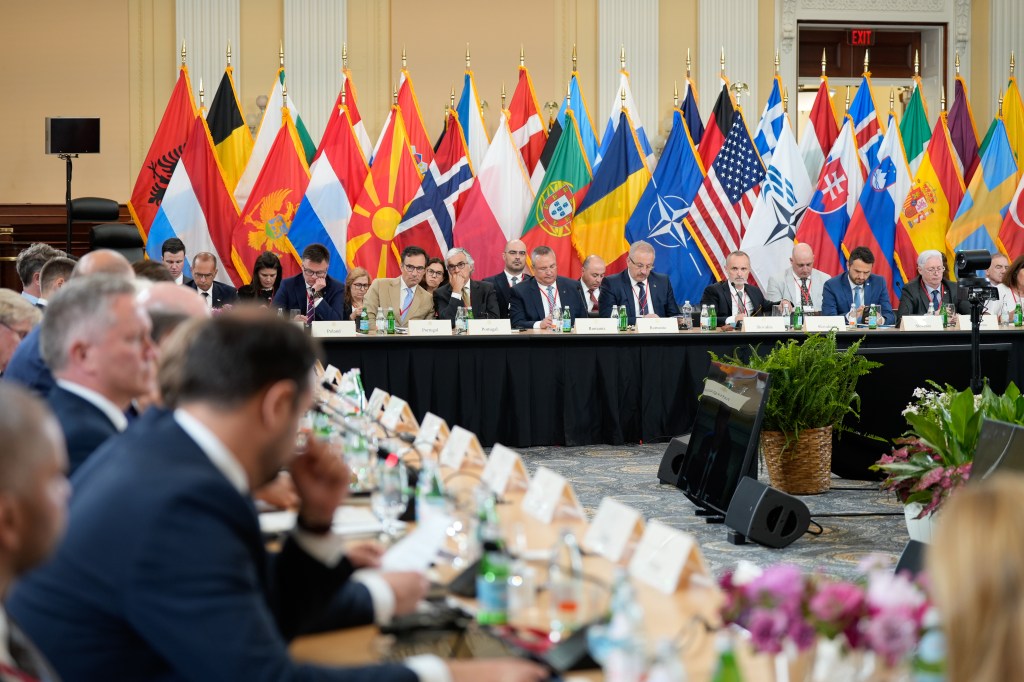
NATO © Saeima / Creative Commons Attribution 4.0 International License / Free for use / Wikimedia Commons
On April 22nd, Germany published, alongside a classified capability profile, its first modern-era formal military strategy, with the title Gesamtkonzeption militärische Verteidigung, introducing a substantial divergence from the country’s long-standing approach to defence. Germany moves away from a crisis management formula towards a focus on conventional defence of Europe within NATO.
Introducing a turning point
Gesamtkonzeption militärische Verteidigung translates roughly as “overall conception for military defence”, and is the culmination of the Zeitenwende, the famous turning point announced by Chancellor Olaf Scholz shortly after Russia’s full scale invasion of Ukraine in 2022. Its central premise is unambiguous: Russia represents the größte und unmittelbare Bedrohung (the greatest and most immediate threat) to German and allied security. It is a new clear-eyed view of Russia which drives a fundamental rethink of the Bundeswehr’s purpose. The German armed forces are being reshaped from an expeditionary force, used to operating in foreign tactical scenarios, into a heavy force designed for high-intensity combat in Europe.
One of the more interesting conceptual shifts in the document is found in the German word Anlehnungspartner, which translates to “learning partner” or, more more meaningfully for the context, “structural backbone”. For decades, Germany saw its role in NATO as a framework nation; essentially, an organiser that helped allies working together. Now Germany intends to build the strongest conventional army in Europe, setting a personnel target of at least 460,000 troops by 2035, including active soldiers and reservists. It also calls for the so-called Vollausstattung, indicating that all units must be fully equipped with their assigned kit rather than sharing equipment pools, a subtle but important change in how Germany thinks about European cooperation. Where Berlin once assumed that capability gaps could be managed through allied pooling and sharing, it now intends to close those gaps at the national level first, making Germany a more reliable and self-sufficient partner from the outset. The document fundamentally suggests that credible cooperation must be built on a foundation of national strength, that the Bundeswehr needs to be aus sich heraus einsatzbereit (ready to fight effectively using its own resources), closing on the traditional French view that cooperation can only be guaranteed when one’s strong enough to be taken seriously on its own.
The American dilemma: Preparing for all scenarios
The timing of this publication is not arbitrary. The German strategy arrives at a time when the United States is making very clear that its primary military focus has shifted to the Indo-Pacific and to the competition with China. The German document acknowledges this openly, referencing the 2026 US National Defense Strategy, and answering to this uncertainty with a single, revealing sentence: “Die NATO muss europäischer werden, um transatlantisch zu bleiben” (NATO must become more European in order to remain transatlantic). Despite the intensity of the debate on the EU-NATO relations, however, this provision is not a move to push the United States out of Europe, but rather a practical recognition that if the alliance is to remain credible, the European members must carry a lot more weight, and, in order to do so, Germany’s plan focuses on three of the many areas where Europe has historically depended on the United States: Moving forces swiftly, distance-striking and nuclear responsibility.
For starters, one of the biggest weaknesses of a purely European defence is the shortage of heavy transport aircraft. The U.S. Air Force’s fleet of C-17 and C-5 cargo planes is essential for moving tanks and heavy equipment quickly. Germany knows it must improve from this specific standpoint, and in fact the strategy document stresses the need for greater Projektionsfähigkeit (the ability to send forces where they are needed, when they are needed). The permanent stationing of a German heavy brigade in Lithuania is the first real test of this capability, as it requires a steady logistical pipeline from central Germany to NATO’s eastern border that must function in a crisis independently of US support.
Next, the emphasis on deep precision strikes and long-range precision weapons is perhaps the most striking military detail in the strategy. The document lists this as a “Priority National Capability Goal” and explicitly connects it to the Nationale Führungsfähigkeit (national command capability). Historically, if European forces wanted to strike targets deep inside enemy territory, they relied on the US for intelligence, targeting data and command of the operation. Germany is now signaling that it wants the ability to do this on its own. This means developing missiles and command systems that can hold targets at risk using German assets and German decision-making processes. It is a capability designed to ensure that Europe can manage escalation even if American assets are tied up elsewhere.
Lastly, the strategy document reaffirms Germany’s commitment to NATO nuclear sharing. Instead of proposing a European nuclear force, it distinguishes a division of labour, where Germany’s job would be to provide the heavy conventional forces which would prevent Russia from achieving a quick victory on the ground, reducing the political pressure to escalate to nuclear use. The underlined idea is to make the German and European conventional shield heavy enough to make the overall deterrence credibility independent from who holds the nuclear trigger.
The main issues: Industry and public debate
The document shows that German military planners have been paying close attention to the conflicts in Ukraine and the Middle-East. It discusses the concept of effiziente Masse (efficient mass) and the need for a mix of high-tech systems and cheaper, scalable technology like drones. The German military strategists have understood that having a small number of exceptional but expensive tanks is ineffective without the ability to replace them or keep up with an enemy producing vast quantities of cheaper weapons. Nonetheless, the paper is much stronger on describing the problem than on providing industrial solutions. It calls for skalierbare Kapazitäten der Sicherheits-und-Verteidigungsindustrie (scalable capacities in the defence industry), but there is no detailed plan for how to turn Germany’s powerful industrial base into a fast-moving arsenal. In a long war of attrition, the ability to produce shells, drones and spare parts matters just as much as the ability to deploy brigades. This, as recently analysed by the Institute, remains a significant gap between European strategic ambition and the economic reality of European defence procurement, which remains fragmented and slow.
It is also important to note that the public version of this strategy is just a summary. The details of the three growth phases (short-term readiness, medium-term expansion and technological superiority by 2039) are all classified. Additionally, while safeguarding operational details from Moscow is necessary, this does create a problem for democratic oversight and puts the German parliament in the difficult position of having to approve a multi-year, multi-billion-euro transformation based on a document it cannot fully debate in public. As a consequence, whether this strategy survives future budget negotiations and Germany’s constitutional debt brake remains to be seen.
Does a stronger Germany mean a stronger Europe?
In conclusion, the Gesamtkonzeption militärische Verteidigung 2026 is undoubtedly a serious document that reflects a Germany ready to lead on conventional defence. It recognises that the old certainties of the post-Cold War era are gone, that Russia is a direct threat, and that the United States is a distracted guarantor. It plans a strategy that works for two different futures: An operational best case scenario, where the US remains heavily engaged in NATO and a stronger Germany takes pressure off American forces, allowing the Pentagon to focus on the Pacific while Europe handles the heavy lifting on land; and a more difficult scenario of significant US withdrawal, where the force described in the strategy document provides the solid centre around which a European defence structure could cohere.
Naturally, the new military strategy does not solve the problems of industrial production or demographic recruitment overnight. Nonetheless, it provides a coherent and credible plan for navigating a period of great strategic uncertainty. It can be pointed out that the insistence on national full equipment may seem to undermine the long-standing European logic of pooling and sharing. The strategy, however, argues exactly the opposite: a Germany that can field complete combat formations on day one relieves smaller allies of having to bridge the gaps, making the whole alliance more resilient. The risk of fragmented national duplication is real, but the document deliberately frames this strength as a contribution to NATO, not as a substitute for it. The task for Berlin and Brussels is therefore to ensure that national readiness and collective defence grow in tandem rather than in tension.
The new German military strategy also carries a distant historical echo. At the start of the nineteenth century, Prussia, defeated by Napoleon, was forced to shrink its army, losing its ability to act independently. In response to that, the Prussian military reformers undertook a slow methodical rebuilding, creating a system of training and reserves that looked modest on paper but could expand rapidly when the right moment came. Naturally, the parallel with 2026 is not exact (the enemy is different, and the alliance framework remains in place) but the underlying logic is familiar: Germany is not breaking from an allied defence system, but it is laying the foundations so that if American attention is focused elsewhere, Europe will not be left defenceless.
Disclaimer: The views and opinions expressed in this article are those of the author(s) and do not necessarily reflect the official position of the Neo Institute Europa. The Neo Institute publishes contributions to foster informed public debate. While articles may be reviewed and edited, the author(s) remain solely responsible for the claims, interpretations and conclusions expressed. This content is provided for informational purposes. The Neo Institute Europa shall not be liable for any loss or damage arising from reliance on this article.

