
Tend and Defend: Circumventing Irregular Mobilisation Risks in Local Turn Peacebuilding
Author: Adrian Brozek
Editor: Adrian Diez Cuadrado
21/10/2026
12 minutes
“Peacebuilding must not impose such identity layers but create the material conditions under which they emerge organically.”
Tend and Defend © Neo Institute Europa
Peacebuilding on a Shrinking Budget
The European Union sustains 22 Common Security and Defence Policy (CSDP) missions and operations across three continents. With its budget and dedication to peace as a core value, but also with the knowledge its institutions accumulated throughout the last decades, it is an indispensable element to international peacebuilding. However, as domestic obligations demand increased spending at home (not least to keep the peace in Europe itself), its recently proposed 2028-2034 budget folds development, humanitarian and pre-accession spending into a single envelope, resulting in peacebuilding competing directly with humanitarian response and neighbourhood stability for funding. As policymakers face increasing calls to cut spending abroad, peace, security and governance allocations have fallen from 25.5% to 19.5% in EU external action budget allocations. Further, seventeen member states have recently cut development aid nationally. Germany, for instance, has halved its humanitarian budget whilst France has cut it by 39%. Under such mounting constraints, peacebuilding expenditure must make rapid gains in efficiency or risk missing its targets.
The greatest predictor of conflict emergence is previous conflict. Efficient peacebuilding must make counteracting the conflict trap its focal point, or risk perpetually wasting money on projects to be undone by the next insurgency. To mitigate societal tensions leading to renewed conflict, the field’s dominant paradigm, the (second) local turn, emphasises community ownership, bottom-up participation and locally embedded peace processes. EU programming is increasingly following this logic across its CSDP missions and Global Europe-funded projects. Though the local approach rests on defensible principles, I argue that an unreflected application of such principles invites a dangerous backfire effect, possibly to the detriment of long-term peace, as peacebuilding that strengthens identity boundaries may inadvertently feed mobilisation dynamics. One possible corrective lies in the stimulation of permeable secondary identity layers throughout peacebuilding efforts.
The Local Turn in Peacebuilding
In light of protracted peacebuilding failures in Iraq and later Afghanistan, likely the most formative conflicts of the early 21st century, top-down liberal interventionism as a tool of conflict management suffered a crisis of confidence. From this emerged scholarly as well as activist calls for a new approach, rooted in community-level engagement and the preservation of traditional social elements in war-affected societies. This “local turn” of peacebuilding holds that local ownership improves the sustainability of peace operations and is therefore more effective. It further lays emphasis on an emancipatory rationale which insists that communities must be allowed to come to peace on their own terms, independent of any (Western) onlooker’s judgement on rationality or justice. On this account, peace formation gains legitimacy through respecting sociohistorical context.
For post-conflict societal organisation, local peacebuilding encourages the recognition of traditional ethnic, linguistic, religious and geographic affiliations, thus of group belonging with characteristically low social permeability. The approach values such relational social identities because the communities they constitute carry genuine legitimacy in the eyes of their members and possess their own conflict resolution mechanisms that predate and often outlast international intervention. As shown by ethnographic field work, informal cooperation, trade and communication persist across communal lines even during active hostilities, thus constituting a form of conflict-defying peace capital invisible to externally designed programmes. Everyday interaction across group boundaries further allows members of opposing groups to develop common bonds and demystify perceived adversaries. The local turn, on this evidence and under the assumption of constructive intergroup interaction, claims productive potential in delimited group-boundaries and constitutes a well-reasoned response to documented failures of liberal interventionism.
Putting this line of thought into practice, the EU-funded Daryeel project in Somalia, for instance, operates through community matching-grants whereby local populations identify their own priorities and co-fund the resulting projects, whilst the EU Trust Fund’s SEEK II programme in the Kenya-Ethiopia borderlands positions community elders and traditional leaders as the primary agents of conflict resolution. In effect, EU-funded peacebuilding affirms local traditional identity boundaries.
However, even the local turn’s own proponents acknowledge that local contexts, whilst empowering through their recognition, may easily be partisan, discriminatory, exclusive and violent. Reactive policies, that then target discriminated-against communal groups through ethnic quotas, electoral rolls or segmented service delivery unavoidably increase the salience of identity difference on all sides. An uncritical embrace of the local thereby easily reinforces communities beyond their initial impermeability into static, bounded entities, preventing fluid identification across them. In Myanmar’s democratic transition, for instance, political inclusion strategies that privileged ethno-territorial power-sharing cemented elite identity politics, making ethnic mobilisation the only avenue for participation in the peace process. The literature identifies this tension but appears hesitant to reconcile it with insights from social psychology into intergroup tensions. I, however, argue that such peacebuilding approaches, if employed blindly, possibly decrease recruitment friction of irregular forces, thus undermining their own potential.
Tend and Defend
Social psychology presents a well-documented mechanism through which group-based self-identification translates into intergroup discrimination. Individuals who derive a substantial part of their self-concept from membership in social groups will seek favourable distinctiveness for their ingroup through comparison with relevant outgroups. Consequential for peacebuilding, the mere act of categorising individuals into groups on possibly arbitrary criteria suffices to produce systematic ingroup favouritism, with subjects maximising relative difference between groups at the expense of absolute gain. Such competitive orientation requires no prior conflict, no material stakes and no historical grievance, but is intrinsic to the categorisation process itself. Regardless of whether group categorisation was intended to empower or to divide, such passive discrimination activates whenever group boundaries become salient. For peacebuilding initiatives that operate through bounded, low-permeability social identities, this implies that the very act of recognising and strengthening communal group boundaries deepens ingroup favouritism and likely produces passive outgroup discrimination.
As ingroup cohesion further increases, social bonds, peer-pressure networks and norms of mutual obligation raise the social cost of defection from collective action to a point where non-participation is sanctioned. Simultaneously, outgroup threat perception rises as individuals increasingly perceive outgroup members as categorical representatives of a rivalling “other”. In Northern Ireland, for instance, despite decades of community-level engagement following the 1998 Peace Agreement, the society’s segregation along non-permeable ethnic boundaries actually increased, independent of relatively frequent intergroup contact.
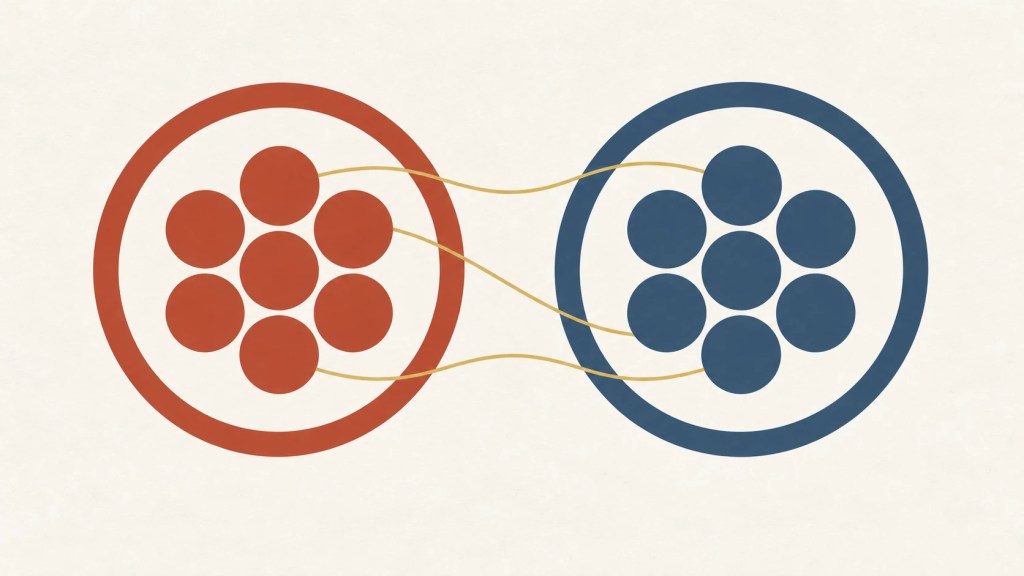
I propose to understand the dual process of simultaneous ingroup consolidation and defensive outgroup othering along behavioural biology’s tend-and-defend concept, which describes a similar pattern across social vertebrates: individuals under heightened group salience readily tend to the ingroup through cooperation, mutual protection and sacrifice, whilst showing decreased readiness for outgroup cooperation, producing passive discrimination from ingroup favouritism.
The tend-and-defend response operates across all forms of social categorisation, but its consequences for the mobilisation of forces are conditioned by the permeability of the group boundary along which it is activated. Where group boundaries are permeable (e.g. professional affiliations, economic interests, voluntary associations) individuals retain the capacity to exit and to realign, which structurally limits the reach of social sanctioning and renders sustained collective mobilisation along those lines difficult. An individual, however, cannot resign from an ethnicity or redefine their geographic roots. Thus, when tend-and-defend operates along non-permeable (e.g. ethnic, linguistic, geographic, kinship) salient boundaries, the simultaneous ingroup consolidation and outgroup othering it yields produce a consolidated target population for mobilisation efforts. As defection from collective action becomes prohibitively costly and defection from the collective is not an option, individuals find themselves in an easily exploitable position. Especially where salience of non-permeable social identities coincides with systematic socioeconomic disadvantage along the same lines, cultural group membership becomes a potent mobilising agent, as occurred in Côte d’Ivoire when political and socioeconomic horizontal inequalities coincided.
Mobilisation Dynamics
In most post-conflict settings where the EU and its member states are engaged in peacebuilding, renewed violence would most likely proceed through irregular forces organised along ethnic lines. EUTM Somalia, for instance, is faced with clan-based mobilisation as a central driver of conflict, and EUCAP Sahel Mali and Niger see jihadist recruitment driven by ethnic tensions between Fulani, Dogon and Tuareg communities. The intersection between the tend-and-defend concept and irregular mobilisation specifically thus deserves added attention. Irregular forces typically recruit through social infrastructure like kinship networks, clan affiliations, tribal bonds and geographically bounded communities, aligning to the non-permeable social identities described above. Where regular recruitment tends to employ rewards-based incentives like salaries or career progression, irregular recruitment will frequently invoke feelings of obligation to relational identities. The argument therefore applies with particular force to irregular conflict, as mobilisation proceeding through relational ties potentially runs into a conducive social environment shaped by tend-and-defend behaviour along non-permeable group boundaries. The local turn’s emphasis on traditional communal identities potentially activates tend-and-defend along the kind of non-permeable boundaries through which collective mobilisation becomes structurally feasible, thus increasing mobilisation effectiveness in case of conflict re-emergence.
But additionally, where identity determines access to education, land, employment and political representation, individuals cannot escape economic precarity through personal effort, because the boundary through which opportunity is allocated cannot be crossed. Here, social identity theory argues that individuals perceiving group boundaries as impermeable are incentivised to abandon strategies of individual mobility in favour of social competition. It thereby becomes a rational economic strategy to take greater personal risks in support of collective action, as individual wellbeing is restricted by the ingroup’s relative hierarchical position. Individuals within non-permeable identity groups are therefore not only susceptible to mobilisation through social sanctioning and foreclosed exit but may additionally possess a rational economic incentive to mobilise, further reducing friction in the recruitment process of irregular forces.
Finally, climate change lends this argument another layer of urgency, as desertification and resource depletion force the migration of geographically bounded communities into outgroup territories. Consolidated non-permeable identity groups will thereby increasingly find themselves in direct rivalry over scarce resources, a dynamic already visible in EUCAP Sahel Mali and Niger, which face situations of desertification driven community displacement. Similarly, the SEEK II programme in the Kenya-Ethiopia borderlands works with pastoral communities forced by drought into competing groups’ territories. Such scenarios of a resource-poor group competing with a traditional resource gatekeeper possibly prevent productive everyday interactions, as the intrusive group cannot incentivise interaction without material benefits to offer. Local peacebuilding’s intergroup conflict mitigation strategy of de-mystifying thereby risks its viability. If tend-and-defend behaviour is then simultaneously inspired along consolidated group boundaries, priming both groups to tend inward and defend outward, eventual mobilisation will profit from beneficial social structure rather than being inhibited by the peacebuilding efforts in question.
EU peacebuilding programming must accordingly pay special attention to relational and rational recruitment mechanisms when affirming traditional social structures in post-conflict societal organisation, or risk evening the field for eventual irregular mobilisation. Without such attention, EU-funded projects may consolidate the social infrastructure through which future recruitment proceeds, working against the stability they are designed to build. An additional layer of caution is constituted by geographic terrain alteration due to climate change, producing precarious social situations as described above.
Post-conflict environments naturally carry an already elevated mobilisation baseline. Conflict itself increases community social cohesion and leaves behind assembled rebel networks, veteran infrastructure and established leadership structures that constitute persistent organisational capital for future mobilisation. I do not argue that peacebuilding alone will inspire mobilisation. Further, local peacebuilding does not create non-permeable group boundaries, as these exist prior to and independently of any intervention, likely constituting contextual factors to any peacebuilding scenario. The concern is, however, that uncritically affirming such social structures underestimates the mobilisation potential this creates. Conflict recurs disproportionately where it has occurred before, which is to say, in environments shaped by peacebuilding efforts after the initial conflict. I argue that conflict re-emergence could proceed much more abruptly and thereby violently under the condition that non-permeable group adherence constitutes local individuals’ focal point of self-conception, and that thereby EU peacebuilding should proceed with added caution when emphasising relational traits over non-relational ones.
Permeable Identity Layers
A strong group identity per se is not the enemy of peacebuilding, whether it activates tend-and-defend behaviour or not. Communal belonging provides psychological security, sustains sense-making and embeds individuals in social networks through which mutual aid, trust and cooperation flow. And as the local turn rightly holds, traditional communities possess conflict resolution mechanisms that often prove more contextually legitimate than internationally designed alternatives. The recognition of these strengths is well-founded, and nothing in the preceding argument suggests that traditional social identities should be forcefully dismantled. The concern lies merely with their uncritical consolidation as the sole axis of post-conflict social organisation, to the exclusion of individualist identity layers that could distribute loyalty across multiple group memberships and thereby introduce friction into irregular mobilisation efforts, should traditional resolution mechanisms fail to prevent conflict re-emergence.
Social psychology’s Common Ingroup Identity Model demonstrates that intergroup bias can be reduced by connecting segregated individuals through shared superordinate identities, thereby counteracting the process of othering. This social re-categorisation does not require groups to abandon their ethnic, linguistic or kinship identities, but recommends self-conceptualisation via a dual identity, retaining subgroup ties, but within binding superordinate categories. As decades of fallout from insensitive interventions have shown, demanding that groups relinquish culturally central identities provokes reactance and possibly worsens intergroup relations rather than improving them. I therefore propose an additive approach: whilst acknowledging existent relational identities, peacebuilding should cultivate an intrinsic secondary layer of permeable identity, rooted in profession, economic interest, shared livelihood challenges or possibly even taste.
Such cross-cutting identification mitigates each mobilisation mechanism described in the preceding sections. Multiple overlapping group memberships distribute loyalty and weaken the consolidation of the entire identity group as a mobilisation vector, especially if members of the secondary identity layer are geographically dispersed and thus support evasive migration. Further, to mitigate social sanctioning punishing group defection, alternative group memberships provide competing normative frameworks that counterbalance ethnic obligation and decrease opportunity costs of primary disloyalty. Finally, where non-permeable boundaries restrict vertical mobility under conditions of horizontal inequality, permeable identities open paths to individual advancement that bypass the group hierarchy. In Bosnia and Herzegovina, for instance, large-scale cross-ethnic working-class protests against corrupt ethno-nationalist elites demonstrated how a supra-ethnic professional identity can shift political framing away from ethnoreligious division and towards shared concerns. These protests then resulted in locally owned democratic structures that international intervention had failed to produce over two decades.
With the evidence laid out above, I propose that future peacebuilding should work to bring about conditions under which individuals can develop self-categorisations around permeable criteria of their own selection. I firmly believe that when a Fulani veterinarian and a Hausa veterinarian independently constitute part of their identity around the same chosen practice, the social tie that results will cross the non-permeable ethnic boundary without requiring either to relinquish it. Peacebuilding must not impose such identity layers but create the material conditions under which they emerge organically, thereby preserving the local turn’s genuine virtues of legitimacy and contextual grounding, whilst simultaneously decreasing irregular mobilisation effectiveness.
Neither Disregarded nor Romanticised
Under conditions of a decreasing development budget, how an individual’s self-conceptualisation makes them vulnerable to mobilisation is a question EU peacebuilding cannot afford to ignore. Traditional communities possess conflict resolution mechanisms that carry greater contextual legitimacy than internationally designed alternatives. EU programming is right to engage these principles. However, tend-and-defend activating along traditional local identities may remove friction costs from eventual mobilisation efforts. Horizontal inequalities and resource depletion are likely to escalate this mechanic, as group boundaries are necessarily entrenched and tensions heightened. In the interest of efficient and lasting peacebuilding and under the impression of shrinking budgets, EU efforts should mitigate such recruitment drivers as much as possible. In doing so, the local is neither to be disregarded nor to be romanticised.
I recommend an additive approach to identity formation: whilst acknowledging non-permeable group membership, peacebuilders should aim to produce the material conditions under which locals can form an individualist secondary identity layer along permeable group boundaries, possibly via occupation or even taste. Accordingly, the EU and its member states should integrate dual-identity cultivation into CSDP mission mandates and Global Europe Instrument programming. Community-level projects should pair local co-governance with cross-community livelihood components that create shared professional identities across group lines. Training missions should build an inclusive professional military identity as a permeable layer. And local governance should stimulate open voluntary associations, clubs and interest groups. Finally, programme evaluations should include identity-permeability indicators alongside existing metrics.
Disclaimer: The views and opinions expressed in this article are those of the author(s) and do not necessarily reflect the official position of the Neo Institute Europa. The Neo Institute publishes contributions to foster informed public debate. While articles may be reviewed and edited, the author(s) remain solely responsible for the claims, interpretations and conclusions expressed. This content is provided for informational purposes. The Neo Institute Europa shall not be liable for any loss or damage arising from reliance on this article.

