
The Power of the Sun: Why Italy’s Energy Security Requires Domestic Renewables, Not Another Pipeline
Author: Thomas Mongardini
Editor: Javier Sutil Toledano
02/04/2026
8 minutes
“Each piece of fossil fuel infrastructure creates a new target, requires new military and intelligence resources to monitor and generates new leverage for the state at the other end of the pipe.”
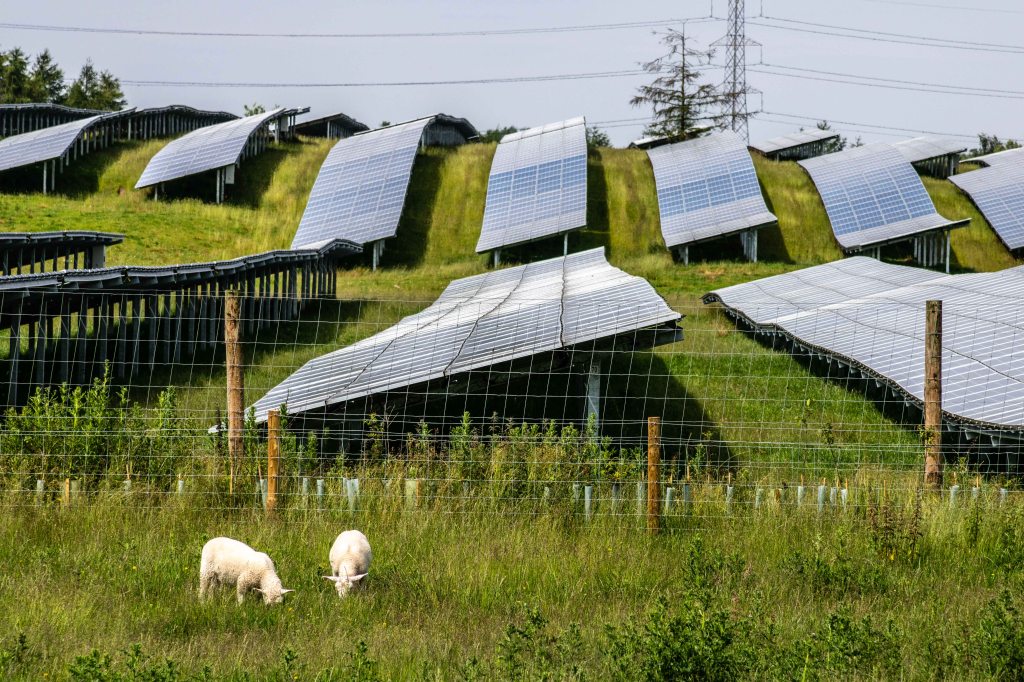
Solar Farm © Peter McDermott / Creative Commons Attribution 4.0 International License / Free for use / Wikimedia Commons
Italy’s Three Warnings
In fifty years, Italy has received three unambiguous warnings that its dependence on imported fossil fuels is a strategic liability: The first came in 1973, when the Arab oil embargo drove global oil prices up by nearly 300% and demonstrated, for the first time at scale, that energy could be deployed as a weapon of foreign policy. The second came in 2022, when Russia’s invasion of Ukraine exposed Italy’s forty-percent dependence on Russian gas, a vulnerability so acute that Rome partially complied with Moscow’s demand to pay for supplies in rubles, bending a declared foreign policy position under energy pressure alone. The third warning is unfolding now, the mining of the Strait of Hormuz, through which flows a significant share of global Liquefied Natural Gas (LNG), including the Qatari supplies Italy acquired at great expense precisely to replace Russian gas, has demonstrated that diversifying fossil fuel suppliers does not eliminate the structural vulnerability, it just merely relocates it.
Each time, Italy’s response has followed an identical pattern. Rather than addressing the root cause, an import dependency rate of approximately seventy four percent that makes it one of Europe’s most exposed large economies. Successive governments have invested political capital and public funds in securing new fossil fuel arrangements: New pipelines, new LNG terminals and new long-term contracts with new authoritarian partners. The Mattei Plan, unveiled by Prime Minister Meloni in January 2024, represents the latest iteration of this logic, binding Italy into a thirty-year supply agreement with Algeria and extending ENI’s operational footprint across a continent where, as the 2026 Relazione Annuale al Parlamento (RAaP) of the Italian intelligence services notes, energy supply chains constitute a priority intelligence domain and Moscow’s use of the energy lever against neighbouring states is formally characterised as economic warfare.
Italy is not only repeating a mistake. It is also institutionalising one. The security case for a domestic renewable transition, for wind turbines in Puglia and solar capacity across the Mezzogiorno, is no longer just theoretical in nature. But it is the observable lesson of every energy crisis in living memory. Additonally, as Italy’s own intelligence apparatus acknowledges in its most recent parliamentary report, hybrid attacks targeting energy infrastructure represent a growing and structurally evolving threat, with cascading failure risks that are highest precisely where dependency is most concentrated: at pipeline entry points, LNG terminals and undersea cables traversing contested waters.
The Mattei Plan: Rebranding Dependency as Strategy
The Italian government’s answer to this cycle is the Mattei Plan, unveiled by Prime Minister Meloni in January 2024 and named, with revealing candour, after Enrico Mattei, the founder of ENI, whose legacy is not the green transition but the construction of Italy’s fossil fuel relationships with the Global South in the first place. The name is not incidental. It is a declaration of continuity dressed as innovation.
The plan presents itself as a new model of partnership with Africa, built around five development pillars: health, education, agriculture, water, and energy. In practice, its energy architecture is inseparable from ENI’s existing operational map. At the moment of its inception, with the sole exception of Ethiopia, every partner country in the plan was a state where ENI already operated. The January 2024 launch in Rome was attended by ENI CEO Claudio Descalzi alongside heads of government, the same configuration that has characterised Italian energy diplomacy for decades, in which the chief executive of a state energy company occupies a seat at the table of sovereign foreign policy. In July 2025, that continuity was formalised with a thirty-year supply and development agreement between ENI and Algeria’s Sonatrach, locking in a dependency relationship with a foreign state for a generation under the banner of diversification. As the ECFR noted in its October 2025 analysis of Italy and the Mediterranean, despite enormous renewable energy potential across the southern Mediterranean, Italian policy under the Mattei Plan has made little concrete progress on clean energy infrastructure while continuing to prioritise hydrocarbon agreements.
The Mattei Plan’s advocates will point to its stated ambition to develop green hydrogen from North Africa as evidence of forward thinking. This argument deserves to be taken seriously and then rejected on security grounds. A solar farm in Algeria exporting electricity to Italy via an undersea cable is geopolitically identical to a gas pipeline from Algeria: The host government retains the ability to cut it, restrict it or weaponise it at will. Algeria has already demonstrated willingness to weaponise its energy exports, suspending its cooperation treaty with Spain in 2022 and threatening to halt gas flows in direct response to Spain’s recognition of the Moroccan autonomy plan for Western Sahara. The generation technology changes; the dependency structure does not. Morocco could do to a Saharan electricity export cable precisely what Russia did to gas flows in 2022. The security variable is not what produces the energy. It is where that production is located and under whose jurisdiction it operates. On this measure, the green iteration of the Mattei Plan offers no more strategic autonomy than its fossil predecessor. Both are exercises in relocating Italian sovereignty to a foreign government’s decision-making calculus.
What makes this particularly striking is that Italy’s own intelligence services have already identified the mechanism. The 2026 RAaP characterises Russia’s use of energy supply as “economic warfare,” documents the cascading failure risks inherent in Italy’s concentrated pipeline and terminal infrastructure, and notes that Italy’s central Mediterranean position makes it a physical and digital hub exposed to threats in direct relation to the energy integration it depends on. The diagnosis is in the official record. Yet, the policy response has not caught up with it.
The Security Case for Domestic Renewables: What NATO’s Own Doctrine Implies
NATO’s posture on energy infrastructure has shifted fundamentally since 2022. The sabotage of the Nord Stream pipelines that September demonstrated that undersea energy infrastructure is a viable and deniable target in active hybrid warfare. The Alliance responded by establishing the Critical Undersea Infrastructure Network and launching Operation Baltic Sentry following further disruptions in the Baltic in late 2024, developing what a NATO Energy Security Centre of Excellence report published in April 2025 describes as an integrated approach to Critical Energy Infrastructure as a defence planning priority rather than a civilian concern. At the 2025 Hague Summit, allies committed to raising defence spending to five percent of GDP by 2035, with up to 1.5 percent dedicated explicitly to protecting critical infrastructure and strengthening civil preparedness.
What NATO has not yet said, but what its own doctrine implies, is that every new pipeline Italy builds from Algeria, every new LNG terminal on its coastline, and every undersea cable it comes to depend on represents an expansion of the attack surface that doctrine is trying to protect. Each piece of fossil fuel infrastructure creates a new target, requires new military and intelligence resources to monitor, and generates new leverage for the state at the other end of the pipe. The 2026 RAaP makes this geometry explicit in the Italian context, noting that attacking a single selected node in the gas or oil chain can generate cascading effects far exceeding the local damage. That is a description of structural fragility, not of a system that further investment in the same infrastructure will make more resilient.
Domestic renewables have a categorically different threat profile. Ukraine, whose energy infrastructure has been under sustained Russian attack since 2022, has drawn the operational lesson directly; as a Ukrainian energy expert told Yale Environment 360, a single missile can take out a coal power station, while destroying a wind farm requires approximately forty. The arithmetic of dispersal is a military argument, not an environmental one. A wind turbine in Puglia or a solar installation in Sicily is harder to target, faster to repair and, crucially, subject to no foreign government’s jurisdiction. It crosses no strait. It transits no chokepoint. It can be neither embargoed nor mined. As IRENA’s 2024 analysis on the geopolitics of the energy transition argues, the old fossil-fuel framework of energy security, centred on supply routes, supplier relationships, and physical infrastructure protection, is structurally inadequate for a renewables-based system, because it transposes the vulnerabilities of one paradigm onto a technology that does not share them.
The counterarguments are real and should be addressed plainly. A sceptic will raise that renewable technology depends on rare earth elements dominated by Chinese supply chains, substituting one dependency for another. The objection is substantive but structurally different in kind: it is a dependency concentrated in the manufacturing phase, not a permanent operational one. Once a wind turbine is installed, it requires no ongoing lithium from Beijing to generate electricity. Once a gas terminal is built, it requires Russian, Algerian or Qatari molecules every single day to function. The asymmetry is total. As the ECFR’s March 2026 report on Europe’s clean energy transition argues, countries that embrace the energy transition through serious regulatory and industrial commitment will be the geopolitical winners of the coming decade, while those that delay risk remaining dependent on fossil fuels sourced from states that have demonstrated their willingness to use them as weapons.
Italy has over 300 gigawatts of renewable project applications currently queued for grid connection, more than six thousand projects awaiting approval. The investment appetite exists and the resource base exists. The southern Italian sun and the Adriatic wind are not the constraint. The constraint is a permitting system so fragmented and politically contested that between 2014 and 2022, Italy added only 8.6 gigawatts of new renewable capacity against a required pace of four gigawatts per year to meet its own stated targets. Spain and Portugal, with comparable solar resources, have moved faster on permitting reform and are pulling ahead on capacity.
What Italy Must Do
In 2022, Italy demonstrated that it possesses the political will and legislative instruments to transform its energy infrastructure at speed when the threat is acute enough. Emergency regasification units were deployed, supply agreements were renegotiated across multiple continents, and a crash storage-filling programme was executed in months. The threat is now equally acute and structurally more permanent. The same emergency logic that unlocked LNG infrastructure in 2022 should be applied to unblocking the 300 gigawatts of renewable projects currently queued in Italy’s permitting system. A government that can install a floating LNG terminal in Piombino in under a year has no procedural justification for allowing six thousand renewable applications to stall indefinitely. Permitting reform for domestic renewables is not a climate policy instrument. It is a national security emergency measure, and it should be legislated as one.
The second imperative concerns the EU framework. REPowerEU has achieved significant results in reducing Europe’s aggregate dependence on Russian gas, but its underlying logic remains one of diversification rather than sovereignty. Diversifying which state supplies Europe’s fossil fuels does not resolve the structural vulnerability that the 1973 embargo, the 2022 gas crisis, and the current Hormuz closure have each demonstrated in turn. Italy is well positioned to lead within the EU on encoding a sovereignty standard into energy security doctrine, one that distinguishes explicitly between energy produced on allied territory under allied jurisdiction and energy imported through infrastructure that hostile actors can target, restrict, or mine. The ECFR’s Energy Sovereignty Index already provides the analytical framework for such a standard. What is missing is a member state willing to champion it politically. Given Italy’s exposure, its Mediterranean position, and its stated ambition to serve as Europe’s southern energy hub, that member state should be Italy.
Neither of these recommendations requires abandoning the Mattei Plan’s genuine development ambitions. Investment in African health systems, agricultural capacity, and education serves Italian foreign policy interests and reflects a legitimate postcolonial reckoning that the plan’s framing, whatever its energy contradictions, deserves credit for attempting. What it does require is intellectual honesty about what the plan’s energy component currently achieves, and the willingness to redirect it. The Sahara holds more solar irradiation per square metre than almost anywhere on Earth. That resource can power African economies directly, reducing the energy poverty that drives the migration pressures the Mattei Plan is also designed to address, without routing it through undersea cables that reproduce Italy’s dependency in a different technological form. But that vision requires a different political architecture than the one currently being built, one centred on African energy sovereignty rather than Italian supply security, and on partnerships that do not replicate, under a green label, the same extractive logic the plan claims to have left behind.
Disclaimer: The views and opinions expressed in this article are those of the author(s) and do not necessarily reflect the official position of the Neo Institute Europa. The Neo Institute publishes contributions to foster informed public debate. While articles may be reviewed and edited, the author(s) remain solely responsible for the claims, interpretations and conclusions expressed. This content is provided for informational purposes. The Neo Institute Europa shall not be liable for any loss or damage arising from reliance on this article.

