
“Water depletion, chemical pollution, microplastics, textile waste, climate emissions and inequitable burdens on producing countries reflect structural failures embedded in supply chains, consumption patterns and economic incentives”
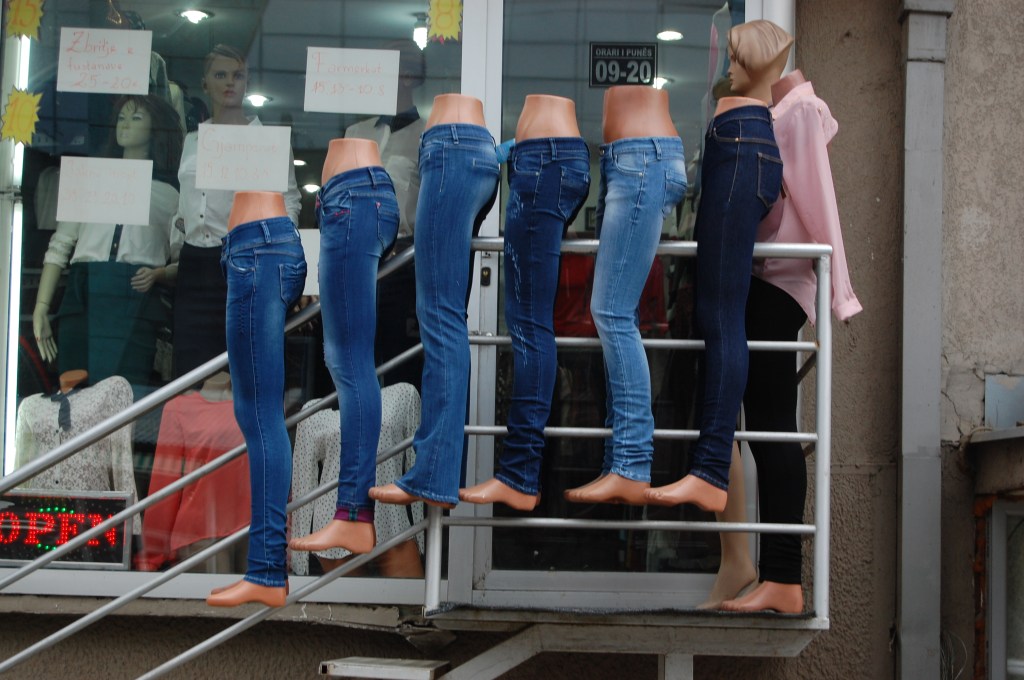
Denim jeans on mannequin legs © Andy Mabbett / Creative Commons Attribution 4.0 International License / Free for use / Wikimedia Commons
The global fashion industry stands today as one of the most illustrative examples of the contradictions of contemporary capitalism, combining creativity, cultural influence and economic dynamism with profound and accelerating environmental and social damage. Over recent decades, fashion has grown into a globalised system valued at more than one trillion dollars and employing hundreds of millions of people across the world. Yet this expansion has been enabled by a linear production and consumption model based on speed, disposability and over-extraction of natural resources. As the impacts of climate change, water scarcity, biodiversity loss and pollution intensify, the ecological footprint of fashion has attracted increasing scrutiny from scholars, international organisations and civil society alike. At the centre of the discussion is a consensus increasingly shared across disciplines: The linear system is fundamentally incompatible with planetary boundaries, and only a transition toward a circular economy model can offer a viable and just path forward.
The Linear Fashion System: Historical Roots and Structural Unsustainability?
The foundations of the linear fashion system, “take, make, dispose”, were laid during the Industrial Revolution, when mechanised spinning and weaving reduced labour requirements dramatically and made mass production possible. For much of the twentieth century, clothing production was shaped by technological advances, industrial organisation and evolving global trade. Yet the core assumption remained constant: that natural resources such as water, land, forests and fossil fuels were abundant and inexpensive, and that environmental sinks could absorb waste indefinitely. As Boulding argued in his seminal “spaceship earth” text, such an approach fundamentally ignores the ecological limits of a closed, finite planet.
The contemporary fashion system represents an intensification of this logic. Synthetic fibres, derived largely from fossil fuels, now represent more than 60 per cent of global fibre production. Traditional fibres such as cotton remain deeply resource-intensive, requiring large quantities of water, fertilisers and pesticides. According to international estimates, producing a single cotton T-shirt can require around 2,700 litres of water, while cotton cultivation accounts for approximately six per cent of global pesticide use. These pressures can be described as fashion’s dependence on “non-renewable resources, natural and synthetic raw materials, water, energy and chemical substances”.
From the late twentieth century onward, globalisation accelerated these dynamics by relocating production to low-cost regions, particularly in developing countries. As UNIDO reports, garment sector wages in many producing countries are substantially below national industrial averages, illustrating the structural reliance on cheap labour. This relocation enabled brands to reduce production costs, shorten lead times and externalise environmental burdens. The EU Parliament emphasised that “delocalisation of production has produced strong disparities,” separating the environmental impacts from the consumption sites and deepening global inequality.
The linear model is also buttressed by the logic of planned and perceived obsolescence. Fashion cycles have accelerated dramatically, driven by marketing, seasonal turnover and trend forecasting. This acceleration is both cultural and economic: consumers are encouraged to view garments as ephemeral, while brands optimise profits through rapid replacement cycles. These intertwined historical, structural and cultural drivers underpin the systemic unsustainability of today’s fashion system.
Behavioural Consumption, Fast Fashion and Systemic Acceleration
Changes in consumer behaviour over the last two decades have been central to the environmental crisis of fashion. As consumption increasingly reflects identity, aspiration and symbolic value, clothing has become a medium for self-expression. The thesis used Maslow’s hierarchy to explain how clothing has moved beyond fulfilling physical and safety needs to addressing belonging, esteem and self-actualisation. In this context, consumption shifts from necessity to emotional gratification, leading to higher purchasing frequency and shorter use cycles.
Fast fashion brands such as Inditex (Zara), H&M, Boohoo and Primark pioneered ultra-accelerated supply chains capable of moving designs from concept to store in as little as two weeks. Inditex, which built a hybrid model combining centralised design with near-shoring and flexible production, became emblematic of speed and responsiveness. The next step in acceleration emerged with ultra-fast digital retailers such as Shein, which uses artificial intelligence, real-time analytics and micro-batch production to launch thousands of new items weekly at extremely low prices. This model intensifies consumption pressures by making novelty constant and affordable.
Promotional cycles reinforce these trends. Events like Black Friday and seasonal sales stimulate impulsive purchases, normalise over-consumption and increase the proportion of garments that will be worn only a handful of times. The Ellen MacArthur Foundation noted that the average number of wears per garment has dropped by around 36 per cent over the past 15 years. In the UK alone, more than 2.4 billion garments sit unused in wardrobes, and hundreds of millions of dollars worth of wearable clothing is discarded each year.
Fast fashion’s business model relies on cheap materials, particularly synthetic fibres like polyester, often blended with elastane or cotton to create low-cost garments that mimic the texture and drape of higher-end textiles. However, these fibre blends are difficult to recycle and degrade rapidly, shedding microplastics into water systems during washing. These fibres can be described as “nearly impossible to recycle into high-quality yarns,” locking materials into a linear pathway that ends in landfill or incineration.
Behavioural, technological and economic mechanisms thus reinforce each other in a feedback loop that accelerates production, shortens garment lifespan and magnifies environmental impacts. Consumption becomes the engine of waste, and disposability becomes a cultural norm.
Environmental Impacts Across the Global Value Chain
The environmental toll of the fashion industry spans the full life cycle of a garment, from raw material extraction to manufacturing, distribution, use and disposal. Although estimates vary, international agencies, academic studies and the thesis converge on several core impacts.
Water is one of the most heavily impacted resources. Global textile production consumes enormous volumes of water, with estimates ranging from tens of billions of cubic metres per year to approximately 79 trillion litres when considering the full spectrum of textile-related activities. Cotton, which represents roughly one quarter of global fibre supply, is particularly water-intensive, and its cultivation often contributes to soil salinisation, groundwater depletion and ecological collapse, as seen historically in the Aral Sea region.
Textile dyeing and finishing processes account for between 17 and 20 per cent of global industrial wastewater. Wastewater often contains heavy metals, azo dyes, formaldehyde, alkylphenols and other hazardous substances. In regions where wastewater treatment infrastructure is lacking, including parts of Bangladesh, Pakistan, India, Vietnam and China, this effluent is discharged directly into rivers, polluting whole ecosystems and creating dead zones with long-lasting environmental and livelihood effects in riverine ecosystems and communities. The thesis highlighted that textile manufacturing uses more than 15,000 chemical substances, many of which present significant risks to both ecological and human health.
From microplastics and Synthetic Fibre to end-of-cycle pollution
Synthetic fibres such as polyester, nylon and acrylic dominate fashion’s material landscape due to their low cost and versatility. However, washing synthetic garments releases microplastic particles into wastewater. The European Environment Agency and the European Parliament estimate that textiles are responsible for approximately 8 per cent of all microplastics entering the world’s oceans. Recent studies in environmental science journals have identified hundreds of chemical compounds associated with these fibres, including PFAS and endocrine disruptors, complicating efforts at containment and remediation.
In addition to the microplastics generated by synthetic fabrics, fashion generates approximately 92 million tonnes of textile waste each year. According to recent assessments building on the Ellen MacArthur Foundation, the vast majority of clothing, roughly 87 percent, is ultimately incinerated, landfilled, or otherwise lost, around 12 percent is down‑cycled into lower-value products, and less than 1 percent is recycled back into new textile fibres, highlighting the persistent challenges in achieving a truly circular fashion system. The thesis noted that most garments are not designed for recycling due to their mixed fibre composition, chemical treatments and creation techniques that impede disassembly. Landfilled textiles release methane as they decompose, particularly natural fibres like cotton and wool. Synthetic fibres persist for decades or centuries, leaching chemicals and microplastics into soil and water systems. The industry’s waste burden is thus not only voluminous but also chemically complex and globally dispersed.
The fashion sector contributes significantly to climate change. According to the EEA briefing, processing and destroying returned or unsold textiles can be estimated to be responsible for up to 5,6 million tonnes of CO2-equivalent greenhouse gas emissions. Energy use in fibre production, dyeing, finishing, transportation and retail all contribute to the sector’s footprint. Synthetic fibre production, tied directly to fossil fuel extraction, embeds carbon emissions at the earliest stage of the supply chain.
Environmental and Social Spillovers, Global Inequality and Injustice
Perhaps the most profound dimension of fashion’s environmental crisis lies in its unequal impacts across the world. Environmental injustice can be defined as a feature of the industry, emphasising that producing countries bear the brunt of pollution and waste despite consuming far fewer garments than wealthier nations.
Countries such as Bangladesh, India, Vietnam, Cambodia, Indonesia and Pakistan produce much of the world’s clothing but lack the regulatory infrastructure to manage the environmental impacts. Textile clusters in these regions frequently discharge untreated wastewater into rivers and wetlands, turning waterways black or chemically contaminated, as documented in the Buriganga River in Dhaka and the Noyyal River in Tamil Nad. These impacts affect drinking water, agriculture, fisheries and public health. Communities living near dye houses and tanneries report higher incidences of skin diseases, respiratory issues and cancers.
The global trade in used clothing, often labelled as “second-hand,” is in reality a waste-disposal mechanism for high-income countries. Ghana’s Kantamanto market receives an estimated 15 million garments weekly, yet only a portion is resellable. The remainder, low-quality fast-fashion items damaged or unsuitable for the climate and local market (mostly in the Global North), end up in open landfills, burned in dumpsites or washed into rivers and oceans in the Global South. Similar patterns occur in Kenya’s Dandora landfill and Chile’s Atacama Desert, where mountains of discarded clothing are visible even from satellite imagery. Thus, these flows constitute a form of environmental dumping, where the Global South absorbs the waste of the Global North and perpetuates an extractivist and abusive system.
The social impacts of the fashion industry extend beyond pollution and environmental degradation. The ILO estimates that more than 60 million people work in the garment sector, many under precarious conditions. The Rana Plaza collapse in Bangladesh in 2013, which killed more than 1,134 garment workers, highlighted systemic failures in building safety, labour rights and corporate oversight. Young women, migrants and informal workers are disproportionately represented in garment production, and environmental hazards intersect with gendered and socioeconomic vulnerabilities. Sustainability must therefore integrate ecological and social dimensions. Environmental injustice, labour exploitation, and waste dumping collectively illustrate that fashion’s crisis is not merely ecological but deeply geopolitical. Gender-specific inequalities are particularly pronounced: Women constitute the majority of garment workers worldwide, often occupying the lowest-paid, most precarious positions and facing disproportionate exposure to hazardous chemicals and unsafe working conditions. Social and economic vulnerabilities intersect with gender, amplifying the impacts of environmental and labour injustices on women in producing countries.
Policies, Regulations and International Frameworks
Although the fashion industry has historically operated with minimal regulation, recent years have seen the emergence of ambitious governance frameworks.
Recent reforms to the EU’s corporate sustainability and due diligence directives have introduced a mixed picture for textile regulation. While the Corporate Sustainability Due Diligence Directive (CSDDD) and the Corporate Sustainability Reporting Directive (CSRD) remain in force, the EU Parliament’s 2025 amendments have narrowed their scope, delayed obligations, and raised thresholds for covered companies. This means fewer firms are immediately required to report on labour, human rights, and environmental impacts across their supply chains, potentially reducing the enforcement of corporate accountability. Nevertheless, the EU continues to advance product‑focused regulations, including the Ecodesign for Sustainable Products Regulation (ESPR) and the Digital Product Passport, which enforce traceability, recyclability, and durability requirements. In practice, this signals that while corporate reporting obligations may have been eased, the traceability of textile products, environmental standards, and circular economy measures remain legally mandated, ensuring that key aspects of sustainable production and supply chain transparency continue to progress. Many regulatory initiatives, like REACH, PEF, eco-labels and extended producer responsibility (EPR), support a transition aligned with SDG 12 toward a circular economy. Global governance actors complement EU efforts:
OECD: Due diligence guidelines for responsible supply chains
ILO: Labour standards for garment workers
UNEP: Circularity frameworks, waste reduction and chemical safety
FAO & UNECE: Promotion of sustainable forest-based fibres through “Forests for Fashion” initiatives
Ecolabels: GOTS, Bluesign, Oeko-Tex, EU Ecolabel
While technological innovation offers pathways to reduce overproduction, increase transparency and enable circularity, Industry 4.0 tools can improve supply chain transparency, enhance operational efficiency, reduce energy consumption, and support more efficient, demand-responsive production systems. For instance, academic research, including studies on AI-enabled sorting pipelines and hyperspectral imaging for textile classification, demonstrates emerging solutions to the sorting bottleneck that limits fibre-to-fibre recycling. While chemical recycling technologies, including depolymerisation and monomer recovery for polyester, show promise, they require capital investment and must be assessed through life-cycle analysis to ensure overall environmental benefits.
Policies, Regulations and International Frameworks
Circular economy represents a paradigm shift from linear extraction and waste toward systems of regeneration, reuse and closed loops. Drawing on frameworks such as cradle-to-cradle, biomimicry and industrial ecology, circular fashion involves slowing, narrowing and closing resource loops:
Slowing: Extending garment life through design durability, repair, reuse and emotional attachment.
Narrowing: Reducing resource inputs per garment through efficiency, material substitution and responsible sourcing.
Closing: Enabling recycling to reintroduce materials into production.
Slow fashion, which values craftsmanship, transparency and longevity, represents a cultural alternative to fast fashion. Rental, resale, repair, upcycling and co-design models are emerging, supported by changing consumer values and digital platforms. However, systemic circularity demands economic, cultural and technological restructuring. Without addressing price dynamics, labour conditions and global inequality, circularity risks becoming a niche market rather than a transformative movement. Moreover, systemic overconsumption, driven by capitalist imperatives for continual growth and profit maximisation, fuels overproduction and accelerates resource depletion, making circular strategies difficult to scale.
The linear fashion system, with its emphasis on disposability and rapid turnover, is fundamentally incompatible with planetary boundaries, particularly in terms of freshwater use, land conversion, chemical pollution and greenhouse gas emissions. Circular approaches must therefore confront both the socio-economic drivers of overconsumption and the ecological limits of the Earth to achieve meaningful transformation.
Toward a Regenerative and Just Fashion System
Water depletion, chemical pollution, microplastics, textile waste, climate emissions and inequitable burdens on producing countries reflect structural failures embedded in supply chains, consumption patterns and economic incentives.
Circular economy offers a coherent and comprehensive framework to address these challenges. It integrates technological innovation, policy reform, social justice and behavioural change into a systemic model capable of reducing ecological footprints while enhancing resilience and equity. The transition requires coordinated action across governments, brands, suppliers, workers, technologists and consumers.
However, achieving sustainability in fashion is not merely a technical challenge but a socio-economic and cultural transformation. The fashion industry must move beyond the aesthetics of sustainability toward genuine systemic change. Its future depends on replacing disposability with responsibility, waste with regeneration and inequality with fairness. If the necessary policies, technologies and behaviours align, fashion can evolve from one of the world’s most polluting sectors into a model of circular, ethical and ecological production. The stakes are high, but so is the potential for transformation.
Disclaimer: The views and opinions expressed in this article are those of the author(s) and do not necessarily reflect the official position of Neo Institute Europa. The Neo Institute publishes contributions to foster informed public debate. While articles may be reviewed and edited, the author(s) remain solely responsible for the claims, interpretations and conclusions expressed. This content is provided for informational purposes. The Neo Institute Europa shall not be liable for any loss or damage arising from reliance on this article.
 Neo Institute Europa