
“Removing a leader does not guarantee a democratic transition.”
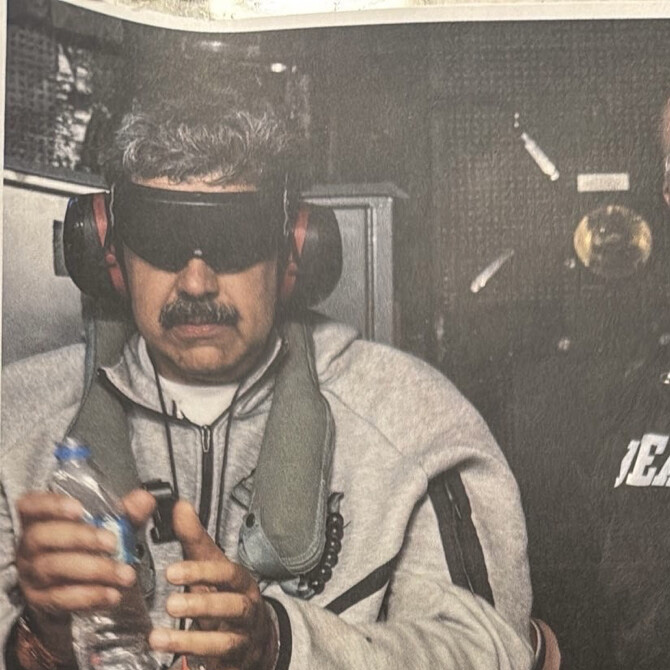
Nicolas Maduro © US Federal Government / Creative Commons Attribution 4.0 International License / Free for use / Wikimedia Commons
The scenes that came from Venezuela on January 3rd, 2026, speak volumes. The illegal invasion of Venezuela by the United States of America and the capture of the, although illegitimate, President Nicolás Maduro, paved the way to a unilateral shift in the way international relations is conducted. The strike fulfilled the first objective of the US in this new world order: Decapitate the authoritarian regime and sow chaos in the region. Ultimately, to tighten its grip.
Although, initially, it was unclear on who would govern Venezuela, US President Donald Trump stated quite clearly that the US would run the country for the foreseeable future, sidelining Venezuela’s democratic opposition and opening the floor to political chaos, instability and ultimately, occupation.
What happened?
In the morning hours of January 3rd, the US military attacked Caracas and other militarily strategic locations, bombing military bases and killing nearly 80 people, including civilians and national and foreign military personnel. The invasion and subsequent capture and abduction of Nicolás Maduro breaks UN (Article 2(4) of the UN Charter), OAS (Article 3 (b, e, g, h) of the OAS Charter), as well as other international conventions and has been therefore deemed illegal by most international observers and researchers. Since then, the US administration continued with low-level bombings and pressured the vice-president, Delcy Rodríguez, to make substantial concessions. Although the Chavista regime remains in de facto power, the US now has a clear say in what Venezuela’s future will look like.
This operation had been months in the making. The current US administration has attempted to paint Nicolas Maduro as a drug baron while bombing supposed “narco-terrorist” drug boats by the coast of Venezuela and Colombia. The signs were there. President Donald Trump and his advisers ignored international condemnation, facts about drug trafficking and even advice from within the administration, pressing ahead in what they described as the final push to stop drugs, most importantly cocaine, from entering the US from Venezuela. Even as reports indicate that around 90% of cocaine entering the US, and a majority of illicit fentanyl, crosses the US–Mexico land border, mostly via Texas, not Venezuela.
The Maduro regime’s human rights violations and the future of Venezuelan democracy
As much as this US administration’s actions have breached international law and signal a return to imperialism in the South American hemisphere, it is important to acknowledge the Maduro regime’s human rights violations. The regime has a long track of political and social repression, with 804 political prisoners, including 102 women and 1 minor, in Venezuelan prisons. Human rights groups reported thousands of arbitrary arrests targeting political opponents, human rights defenders and journalists, with hundreds of children among those detained. Reports also documented torture and other ill treatment of detainees, including women and children. The repression has been brutal, systematic and consistent, sparking international condemnation for years. According to Venezuelan NGOs, several hundred people have been killed by the state, and or its shadowy proxy guerrillas and paramilitary groups since 2002.
The latest case of widespread repression came after the 2024 presidential elections. The deeply contested elections, which were full of irregularities and inconsistencies; ultimately confidently rigged by the regime was followed by a wave of repression. Despite calls from the EU and regional governments such as Brazil and Colombia for transparency, the authorities did not publish the full, disaggregated voting records needed for independent verification. Human rights organisations described abuses in detention centres, including beatings, suffocation, electric shocks and threats, as well as sexual violence against women. By the end of the year, more than 7.89 million Venezuelans had fled the country.
Having acknowledged this, removing a leader does not guarantee a democratic transition. Venezuela’s 2024 election crisis was fundamentally about verification, legitimacy and ultimately, the latest fight for democracy in a country hungry for change. In that context, images of some Venezuelans celebrating Maduro’s capture are understandable, but they do not constitute a mandate for external regime change, nor do they guarantee that the opposition’s claimed victory translates into power. More importantly, reporting suggests that much of the governing structure remains in place, just without Maduro. To the surprise of many in the Venezuelan diaspora, Trump brushed aside any suggestion that the opposition leader and Nobel Peace Prize winner Maria Corina Machado would take over, saying she lacked support.
Venezuela is now in a state of survival and stiff anticipation. As things stand, the US administration has taken complete control over the state of affairs in Venezuela, while maintaining the Chavista governing apparatus and keeping the ruling class to oversee a new neocolonial protectorate, as Venezuelan sociologist Malfred Gerig has described the current reality of Venezuelan state capture by the US. The international community, especially fellow Latin American countries, remain nervously waiting for the dice to fall.
However, it is important to celebrate the end of a dictatorship while understanding the consequences of this invasion on national sovereignty, international law and the world order. Condemning the invasion of Venezuela and the capture and abduction of a dictator does not mean condoning a brutal regime and its human rights violations. As the U.S. has immediately pivoted to control the production capacity of oil and other minerals, controlling revenue flows and licences, even pressing the Venezuelan “puppet regime” of Delcy Rodriguez to change the law to allow for foreign oil reserves, the message to Venezuelans is not one of “democratic restoration” but of transactional continuity, with sovereignty traded for “stability”. As it seems that the US will push hard to cement the “legitimacy” and “desirability” of the newly established protectorate, while earning billions for American and, in lesser amounts, Venezuelan elites. A democratic transition in the short or medium term is looking increasingly unlikely.
Still, for many people in Venezuela, the ousting of Maduro has proven a complete betrayal of the Venezuelan people awaiting a democratic transition. Uncertainty and anxiety are common feelings throughout Venezuela, with social liberties and political rights still suspended, as well as access to electricity, water, medicine and food gravely affected by continued sanctions, instability, supply chain issues, widespread poverty and the threat of a renewed military incursion by the U.S.
Meanwhile, the Chavista regime is still in power, with Maduro’s vice-president, Delcy Rodríguez, now having been appointed by the Supreme Court and the National Assembly as president of Venezuela. This begs the question; was the easy capture of Maduro orchestrated from within the regime? Only time will tell, but the Trump administration considers Rodríguez as the only available partner to conduct its business in the country, thus keeping the regime in power, although for considerable concessions and power over future decisions on the economy and natural wealth of the country. Reports of widespread human rights violations and repression after the capture of Maduro by the regime paint a telling picture of a government fighting to keep control over the situation in the country and asserting its power over the population. A regime not entirely built on a cult of personality, at least not since the death of Hugo Chavez, but reliant on complete capture of the state by the military, bureaucrats, party loyalists and businessmen. The regime change orchestrated by the US has fundamentally changed the logic of the Chavista regime. It went from what it self-described as “anti-imperialist” and revolutionary to a captured regime controlled by the US, much like a mafia has to adapt when the boss is captured.
Ultimately, the complete capture of the Venezuelan political apparatus, economy and society by the US has the ultimate goal of establishing a neocolonial protectorate in Venezuela. The goals are two-fold: First, by capturing Venezuelan mineral wealth, the US administration has protected the interests of its oil and mineral barons, who have supported Trump throughout his two presidencies and demanded new frontiers for oil and mineral extraction, steady business perspectives and to continue the extractive and polluting business in the midst of a pushback against climate science and emission reduction policies around the world. Secondly, Venezuela was the stepping stone for a renewed push for the control of the hemisphere and the logic of spheres of influence and control by the world superpowers. This regime change will become the prototype of future regime changes orchestrated by the world powers. As Andrés Izarra put it:
“The strategic triumph has been to achieve effective control of Venezuela without paying the cost of nation-building. There is no institutional reconstruction, no disarmament of militias, no creation of new security forces. There is no occupation with thousands of soldiers for a decade. There is no insurgency, no power vacuum, no chaos to manage. […] And it all worked because Maduro’s regime was not revolutionary, but mafia-like. And mafia states, by their very nature, are transferable”.
Ultimately, the maxim of the new world order is: “Do not destroy states. Capture them. Do not occupy territories. Control elites. Do not build nations. Redirect existing ones.” It does not represent liberation, but neocolonial appropriation. A useful analogy to understand the current state of geopolitical supremacy might come from the business world, with the concept of a corporate hostile takeover. “In such takeovers, a firm responds to a competitor by acquiring it rather than destroying it. The acquiring firm makes personnel changes, preserves its core operations, and redirects profits to itself. The goal is control, not dismantlement”.
All for the black gold
All the rhetoric and talk, all the bombings and threats, were all part of the plan to invade Venezuela, depose the autocrat Maduro and get a hold of the world’s largest proven crude oil reserves. Again and again, the US has searched for justifications for its invasions and wars, so as not to say the obvious upfront. The US is addicted to oil, especially foreign oil, and will do anything in its power to get it. Oil has acted as a quiet organising principle of U.S. foreign policy, influencing which crises receive pressure and which receive accommodation. Previous administrations played the diplomatic or democratic card, but the Trump administration has finally taken off the mask of the world’s “democratiser in chief” and has gone full throttle on its quest to a colonial empire with a “new old world order”.
Restoring pre-sanctions production levels in the country with the world’s largest estimated crude oil reserves could cost tens or even hundreds of billions of dollars. This US administration has stated that US taxpayers may reimburse oil companies for the rebuilding of infrastructure. The US administration is actively pushing American oil companies to exploit Venezuelan oil reserves, just as they did in the Middle East in the past. Additionally, Venezuela is also a major mining country, having reserves of copper, coal, nickel, magnesium, silver, zinc, titanium, tungsten and uranium. The US, in its ambition of beating its big-country competition, has seen Venezuela as a golden goose ripe for exploitation. Imperialism has officially returned. Countries like the US, Russia and China have come to, unfortunately, understand that imperialism, exploitation and colonialism are the best and most effective tools in this multipolar world order to guarantee a monopoly on power and resources. There is a “consensus within an administration committed to hemispheric primacy”.
As it stands, the Global South will unfortunately continue to be at the mercy of the world’s superpowers, suffering economic, environmental and societal exploitation for the benefit of the few. Latin America, naturally, falls under the watchful and exploitative eye of a US detached from legal constraints under an administration that is only the culmination of a long plan of capitalist oligarchs. The international system is now increasingly influenced by an elite completely detached from reality and from the perils of ordinary life. The Global South is often portrayed as a faraway place full of riches waiting to be exploited. Ultimately, ordinary people will bear the brunt of the consequences of this new imperialism, which aims for complete domination of natural resources and does not stop at human rights to ensure the continuation of business-as-usual for corporations.
A new world order
The language coming out of Washington increasingly sounds like a Monroe Doctrine revival. A claim to special rights in “our hemisphere” that treats sovereign states as a strategic backyard rather than equal partners. That posture does not just destabilise the target country. It radiates outward, damaging alliances and partnerships that take decades to build, but can be weakened in months by one administration through coercion, threats and unilateral force. The Greenland episode is a case in point: Trump’s renewed push for U.S. control has triggered open alarm in Europe and prompted discussions of NATO responses in the Arctic precisely because allies fear the precedent and the strain on collective security.
This ambition may not appear to stop at Venezuela. Soon after the Venezuela ordeal, Trump publicly floated military action against Colombia, then pivoted to a “cordial” call and an invitation to Colombia’s president Gustavo Petro after a period that included visa sanctions, rhetorical escalation and discussions within Colombian opposition of an imminent American incursion in Colombia, turning bilateral relations into a mix of intimidation and transactional bargaining. Mexico is hearing the same rhetoric; Trump has threatened “land” action against cartels, prompting Mexico’s president, Claudia Sheinbaum, to warn that unilateral operations would violate sovereignty, even as she seeks closer coordination to avert a worst-case scenario. Cuba is now explicitly in the crosshairs as well, with Trump saying the island will receive “zero” Venezuelan oil or money and urging Havana to “make a deal.” At the same time, U.S. reporting frames Cuba’s economic fragility as part of the administration’s leverage calculus.
The United States has watched this Hollywood film before, even as the Trump administration promised to end the era of “forever wars”. From Vietnam to Iraq, ordinary Americans footed the bill while major contractors such as Lockheed Martin and Raytheon captured much of the upside. Afghanistan became the clearest symbol of that model, and academic accounting puts the post-9/11 wars at roughly $8 trillion, alongside staggering human costs. The unavoidable question is what $8 trillion might have achieved if it had been invested in real security at home, infrastructure, health or resilience, rather than in prolonging conflict. Regrettably, US taxpayers will never get to see that alternative history.
That is why Greenland matters beyond the Arctic. NATO and the European project are not only military arrangements, but they also represent trust structures built over generations. Even if the alliance survives a crisis, the damage will take multiple administrations to repair. European voices are already warning that treaty credibility is endangered when the most powerful ally threatens coercion against another. This is also why the “European army” debate is shifting from theory to urgency. The EU is already positioning security cooperation with Japan as part of that trajectory, and analyses of NATO’s engagement with Indo-Pacific partners (Japan, South Korea, Australia, New Zealand) point to a widening network of democracies coordinating on shared risk in a world with the current US administration.
If Washington normalises unilateral “decapitation” as a tool of international statecraft, Beijing can point to that template to argue that force is simply how major powers resolve “internal” disputes, especially while it frames Taiwan as a domestic question and reiterates that “reunification” is inevitable. The risk is sharpened by the way 2027 is already treated in strategic circles, not because the Chinese Communist Party has publicly declared it as a deadline for unification, but because multiple assessments link it to a milestone for People’s Liberation Army readiness, with U.S. intelligence and officials arguing that Xi has directed the military to be capable of taking Taiwan by that point, even if capability is not a fixed decision date. In other words, as the “readiness window” approaches, blurring the line between lawful pressure and unlawful intervention does not deter coercion. It makes coercion easier to justify, and it gives Beijing rhetorical cover to claim that what it is contemplating is merely the new global norm in a multipolar order. Ultimately, as Ben Steil, Director of International Economics at the Council on Foreign Relations, put it: “I suspect, the liberal world order has witnessed its final dawn”.
The core lesson from Venezuela is that modern interventions can aim less at “nation-building” and more at control by redirecting an existing state through pressure on elites, institutions and revenue flows, while leaving much of the governing machinery intact. If US military pressure on Iran continues to intensify, the danger is not only escalation, but the shape of what follows; a fractured sovereignty where internal repression persists and external leverage grows, without a clear pathway to legitimate transition. Iran’s protest movements, and the fact that demonstrators have been killed, underline that the internal demand for change is real. But an intervention logic can still marginalise those forces, replacing a domestic struggle for accountability with an externally managed “stability” deal that entrenches impunity and prolongs uncertainty for ordinary people.
In the end, the bleakest part is generational. The spiral risk is rising, and the decisions are being taken by leaders grotesquely older than the people who will live with the consequences longest. A world in which force becomes the default tool, deals replace institutions and sovereignty is conditional on strategic value, is a world that offers younger generations only crisis management, not progress. The tragedy is that it did not have to reach this point, but once coercion is normalised, stability becomes something societies have to buy back over decades, at a cost younger generations will inherit.
Disclaimer: The views and opinions expressed in this article are those of the author(s) and do not necessarily reflect the official position of Neo Institute Europa. The Neo Institute publishes contributions to foster informed public debate. While articles may be reviewed and edited, the author(s) remain solely responsible for the claims, interpretations and conclusions expressed. This content is provided for informational purposes. The Neo Institute Europa shall not be liable for any loss or damage arising from reliance on this article.
 Neo Institute Europa