
“It is no longer a space to be preserved, but one that is entering history as a theatre of power”
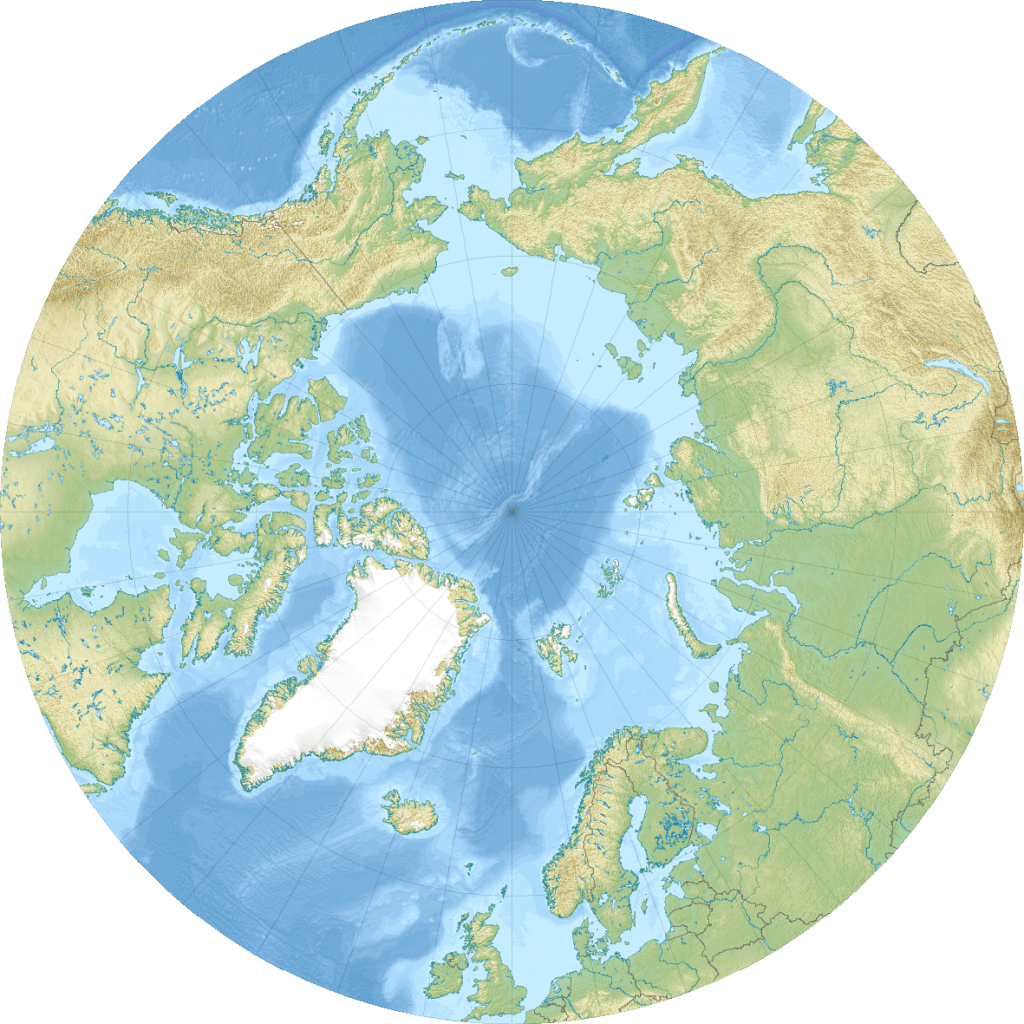
Relief location map of the Arctic Ocean © Uwe Dedering (Dec, 2010)
In the first weeks of January 2026, the Arctic has moved to the centre of international attention. The US threat of a possible annexation of Greenland has triggered harsh reactions from Denmark and the European Union, with some analysts and policymakers even evoking the end of NATO, should Washington resort to military action. Beyond the communicative style of the current US administration, these diplomatic skirmishes point to a deeper structural shift: The Arctic is no longer a periphery of international politics, but one of its new strategic epicentres. Increasingly, what for centuries was the Mediterranean for Europe, an internal space of competition over trade and security, is moving northwards. In this context, Greenland has acquired strategic value and is now consistently treated in Washington as a national security dossier. The fact that the United States now sees the Arctic, and therefore Greenland, not as a domain of transatlantic cooperation but as a space of exclusive strategic sovereignty, in line with a new “Donroe” doctrine, opens a particularly consequential geopolitical rift for Europe.
Greenland within the Arctic’s strategic re-centralisation: The Arctic maritime corridors
Greenland’s strategic importance is not new. Geographically, the island is the northeastern bastion of the North American continent and dominates two of the three maritime gateways to the Arctic Ocean. In military terms, it is an advanced platform for aerospace surveillance, a crucial node for North American defence, and a key element of the GIUK-N corridor (Greenland–Iceland–United Kingdom–Norway), the maritime space linking the Arctic to the North Atlantic. Today, however, this centrality has taken on a new meaning. As the ice melts, the Arctic is no longer a natural buffer between great powers; it has become, and will increasingly become, a traversable, contestable and exploitable space. This is where the strategic ambitions of the United States, Russia and China converge and collide.
Washington views Greenland as a “fourth shore” of its national security, such that losing political and military control of the island would mean defending the American continent not from afar, but at its very borders. A strategic logic which extends beyond sea and airspace towards the space domain, as programmes such as Golden Dome integrate defence architectures that link orbital and terrestrial assets within a single command-and-control framework in whose context Arctic and Greenlandic ground stations emerge as essential communication nodes for real time ISR flows (intelligence, surveillance and reconnaissance data). Moscow sees the Arctic as the core of its nuclear deterrence. And Beijing, while not an Arctic state, has defined itself as a “near-Arctic power” and is investing in infrastructure, scientific research and polar routes to reduce its dependence on maritime chokepoints controlled by the United States.
The gradual opening of polar sea lanes is among the main drivers of the Arctic’s growing strategic centrality. The Northern Sea Route (NSR), running along Russia’s coast and often described as the Polar Silk Road, links East Asia to Europe through the Bering Strait and the Barents Sea. The Northwest Passage cuts through the Canadian Arctic Archipelago. The Transpolar Sea Route is expected, in time, to cross the very centre of the Arctic Ocean. With the Arctic Bridge seasonally connecting North America (Canada) to Eurasia (Russia).
The appeal of these routes lies in their capacity to shorten transit times between the main economic hubs of Asia, Europe and North America. Arctic passages are at least 5,000 nautical miles shorter than conventional routes, with potentially enormous impact. A ship sailing from Hamburg to Shanghai can reduce its journey from roughly eighteen days via Suez to about eleven days through the Arctic. On other axes, such as Yokohama-Rotterdam, distances can shrink by up to 40%. Moreover, as ice retreats, large tankers and ultra-large vessels that currently cannot pass through the Suez or Panama Canals, or that face seasonal restrictions, will increasingly be able to navigate the Arctic year-round.
Beyond economics, however, several geopolitical factors make these routes objects of contention. Access facilitates the exploitation of vast deposits of hydrocarbons and critical minerals, especially rare earths. Arctic corridors also allow states to bypass sensitive chokepoints such as the Suez Canal, the Strait of Malacca, and above all Bab el-Mandeb, as the Horn of Africa and the Arabian Peninsula grow more unstable. Arctic routes thus become a matter of security, not merely of commerce. They challenge the strategic centrality of the maritime chokepoints that dominated twentieth-century geopolitics, spaces where crises, piracy, or conflict can paralyse entire global value chains. The Arctic offers an alternative choice: Not yet fully mature, but sufficiently credible to attract investment and strategic planning. For China, this means reducing vulnerability in the South China Sea and the Malacca Strait. For Russia, consolidating economic sovereignty over the Northern Sea Route. For Europe, potentially diversifying supply lines.
From cooperation to strategic competition: Europe’s Arctic challenge and the Nordic deterrence model
For decades, the Arctic was portrayed as an exceptional space: A realm of scientific cooperation, multilateral governance and environmental diplomacy. That paradigm collapsed with Russia’s invasion of Ukraine in 2022. Since then, the Arctic Council has been paralysed, cross-border cooperation suspended and the region has become a direct extension of the strategic confrontation between NATO and Russia. Finland and Sweden’s accession to the Alliance marked the end of Nordic neutrality and pushed the frontier of Western deterrence deep into the High North. The Kola Peninsula, for example, has shifted from a monitored sector to a genuine frontline. Russia has reconfigured the defence architecture of its Arctic bastion, reactivating Soviet-era bases such as Olenegorsk, Nagurskoye, Severomorsk, Ostrovnoy and Vorkuta, all aligned along the Northern Sea Route. Meanwhile, Beijing has intensified cooperation with Moscow in energy and logistics, using the Arctic through Jiangsu’s port and its COSCO’s fleet as a platform for global projection, and scientific collaboration as a tool of soft power. In this context, the vision of the Arctic as a zone of peace and cooperation increasingly appears as a relic of the past.
It is here that the fragility of Europe’s position becomes evident. The European Union acknowledges the Arctic’s strategic importance, yet continues to frame it primarily in terms of diplomatic cooperation, environmental sustainability and economic development. Its strategy, “updated” in 2021, emphasises climate policy, multilateral governance, Indigenous rights and strategic autonomy in critical raw materials. All essential goals, but insufficient, and increasingly impractical, if the United States, Russia and China are rewriting the rules of the game. And yet the EU is, in every sense, an Arctic power, and could find within itself the foundations of a credible common strategy, as Sweden offers a revealing case. Russia’s invasion of Ukraine marked a profound turning point for Stockholm, transforming its Arctic posture from defensive realism, focused on stability and cooperation, to offensive realism, centred on deterrence and power projection. The Arctic is no longer treated as a separate theatre, but integrated into the concept of närområde, the “immediate neighbourhood” of national security. In a politically significant declaration, Sweden has affirmed that it is an Arctic country. This shift has produced concrete outcomes. Militarily, Stockholm has rebuilt units specialised in Arctic operations, such as the Norrland Dragoon Regiment in Arvidsjaur, and reorganised infantry forces for northern deployments. Strategically, it has abandoned the traditional dual-track policy toward Moscow, recognising that in an increasingly bipolar environment security can no longer rest on the hope of shared stability alone. NATO membership completed this transformation; Sweden entered not as a passive actor, but as a provider of expertise, assuming leadership roles in Nordic deterrence.
Here, the European Union could find a model for strategic direction. First, by integrating the Arctic into the core of European security instead of treating it as a diplomatic periphery. Second, by investing in genuine Arctic competence, leveraging the specific capabilities of Nordic member states to build specialised deterrence rather than generic defence. Finally, by abandoning the illusion that the region can be governed solely through environmental multilateralism, and recognizing that today the Arctic is, above all, a space of power.
The Arctic as the new Mediterranean
The Arctic has become the new internal sea of the great industrial powers. It links America, Europe and Asia; concentrates strategic resources, reshapes global trade routes and hosts some of the world’s most sensitive military infrastructures. In every respect, it is the Mediterranean of the contemporary world.
Fernand Braudel famously argued that the Mediterranean is not merely a sea, but a system of seas, a space where the longue durée of geography and deep structures ultimately prevails over events and intentions. For centuries it was portrayed as a crossroads of civilisations. Then, between the sixteenth and seventeenth centuries, it entered history as a theatre of empires. In that transition, Spain realised it could not preserve the Mediterranean as a neutral space, but could make it governable; not through proclamations, but through a network of outposts, naval bases and strategic red lines that transformed an unstable sea into a system under control.
Today, the Arctic stands at a similar juncture. It is no longer a space to be preserved, but one that is entering history as a theatre of power, and it will not be shaped by those who invoke its exceptionalism, but by those who accept its centrality.
Disclaimer: The views and opinions expressed in this article are those of the author(s) and do not necessarily reflect the official position of Neo Institute Europa. The Neo Institute publishes contributions to foster informed public debate. While articles may be reviewed and edited, the author(s) remain solely responsible for the claims, interpretations and conclusions expressed. This content is provided for informational purposes. The Neo Institute Europa shall not be liable for any loss or damage arising from reliance on this article.
 Neo Institute Europa