
“The balance of power in the U.S. has been subtly chipped away at in favour of the presidency for almost two centuries, undermining Congress’ elected officials and the Supreme Court while approaching the tyranny the Founding Fathers feared.”
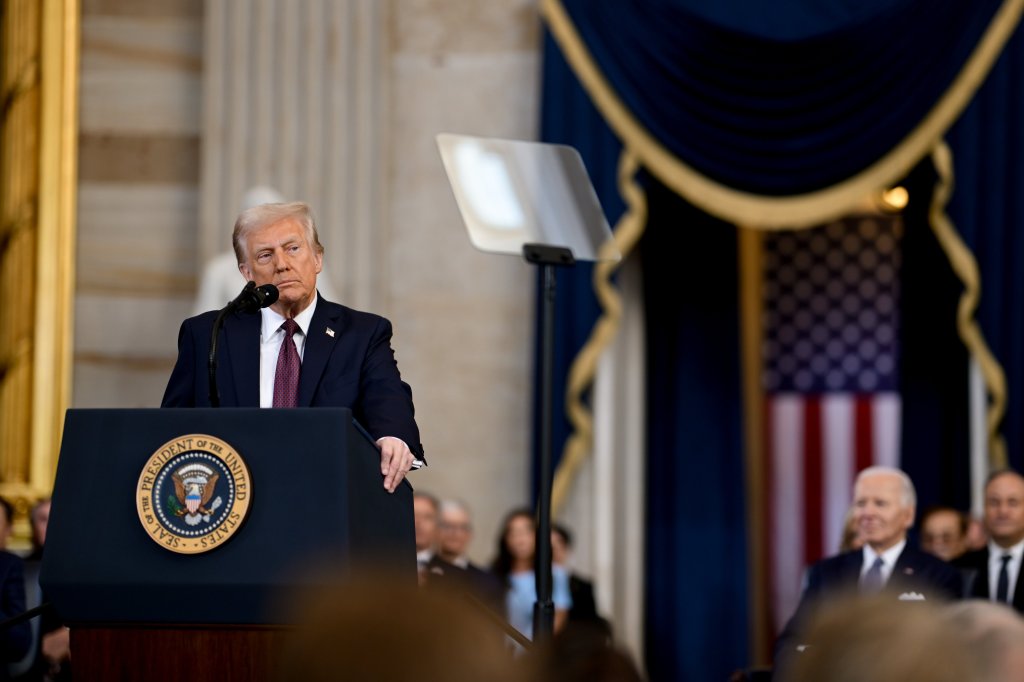
President Donald Trump delivers inaugural address (2025). © The Trump White House / Creative Commons Attribution 4.0 International License / Free for use / Wikimedia Commons
On the 3rd of January 2026, the United States launched a military operation in Venezuela that led to the capture of Venezuelan president, Nicolás Maduro. By Monday the 5th of January, fears of the U.S. annexing Greenland were renewed when, during a CNN interview, U.S. Homeland Security Adviser Stephen Miller proclaimed that Greenland should belong to the United States. Two days later, the U.S. made headlines again after an ICE officer killed 37-year-old Renee Good while she was protesting an ICE operation in Minneapolis, Minnesota.
All this unfolded within the span of a single week. Each event on its own would be concerning. However, taken together, they reveal something mouldering at the core of the U.S. government.
To see how much the U.S. has changed, it is important to look at the pattern that these events reveal. In Venezuela, the executive branch of the United States conducted military action in a foreign country with critics arguing there was virtually no congressional oversight. Trump did not attempt to inform Congress of his actions, let alone seek approval, undermining the U.S. Constitution and the War Powers Act of 1973, which requires the president to consult Congress before military action or, at the very least, notify Congress shortly afterwards. Furthermore, following Trump’s actions in Venezuela, Congress failed to pass a resolution to block additional military action in Venezuela.
Then there is the question of international law. Indeed, Maduro was the leader of a socialist authoritarian regime, and many Venezuelans reportedly celebrated his capture. But the United Nations Charter clearly restricts the use of unjustified military force between states. While it is complicated in practice, the U.S. is bound to uphold international agreements it signs onto. The only justification Trump’s administration offered is that this was not an act of war against Venezuela, but part of the war on drugs and a defence of U.S. interests in the Western Hemisphere. This reasoning is already under criticism from legal scholars.
In a similar vein, Trump’s call for Greenland also stands in tension with international law. Denmark has firmly expressed that it opposes Trump’s claim to the island and the vast majority of Greenlanders are also against a U.S. takeover. But this administration has not even ruled out military action in this situation. That is not even mentioning what would happen to NATO if the U.S. were to use force in Greenland.
Then, on the domestic front there is the killing of Renee Good. The Trump administration has continued to claim that the ICE officer, Jonathon Ross, acted in self-defence against Good, who was a domestic terrorist trying to run Ross over with her car. Yet video evidence seems to contradict that, showing Good trying to de-escalate the situation and turning her wheels away from the officer before being shot and killed.
Adding to this, local officials are outraged over the killing, while being simultaneously denied access to evidence and the opportunity to investigate with the FBI. The Justice Department has also declined to open a civil rights investigation. Then there is ICE itself, a masked federal immigration police, whose tactics Americans are increasingly critical of. In addition to detaining undocumented migrants, legal visitors and green card holders, ICE has even started detaining U.S. citizens, with critics now calling ICE “Trump’s secret police”.
These situations all show a serious lack of accountability and transparency as well as a disregard for rule of law and democratic norms on the part of the current Trump administration. Trump is getting away with doing what his administration wants with not even the law stopping him. Essentially, the United States is becoming an autocracy. But, while shocking, this development did not occur in a vacuum. There was a gradual systemic turn of events that brought the US to this situation.
Upon creating the Constitution, the Founding Fathers of the United States designed a system with three branches of government. Especially fearful of tyranny, they made sure to build checks and balances into the system so that neither branch could become too powerful. Americans have been taught to believe that this balance of power continues to exist in perfect harmony. However, it does not. The balance of power has been eroding in America for almost 200 years.
One of the earliest examples of this can be seen with Andrew Jackson, who infamously weaponised the presidential veto power and is credited with establishing the norm of the president as the voice of the people. Not long after, Abraham Lincoln also enlarged the presidency. Responding to the national emergency that was the Civil War, he expanded the role of Commander-in-Chief, ordered military action without congressional approval and suspended habeas corpus.
Nearly a century later, Franklin Roosevelt pushed executive authority further than anyone before him. Over an unprecedented four terms in office, he created several executive branch federal agencies to deal with the Great Depression, deployed military troops to Greenland without congressional approval, strengthened his role as Commander-in-Chief during WWII and sent over 100,000 Japanese Americans to internment camps. The impact of his expansions would go on to change the presidency forever.
The Cold War era saw Truman, along with several other presidents, continue this trend through executive involvement in foreign affairs and the creation of a permanent intelligence apparatus within the executive branch, all in the name of national security interests. Later, Lyndon B. Johnson turned congressional approval for a brief resolution into permission to plunge the U.S. into a full-blown war in Vietnam. This, along with actions by Nixon, pushed Congress to pass the War Powers Act of 1973 that presidents have stretched ever since. Nixon also used the presidency to spy on his rivals, pay hush money, obstruct justice and lie to Congress during the Watergate scandal. Then the Reagan administration saw illegal weapons sales and a series of ideological Supreme Court appointments that continue to shape the courts to this day.
After 9/11, executive power ballooned, with Congress itself helping to push it forward. The Bush administration expanded its intelligence apparatus, authorised mass surveillance, including on American citizens, detained and tortured mostly Arab and Muslim men and established military tribunals. Congress also passed the Authorisation for Use of Military Force Act, giving the executive branch open-ended authority for military action. Even the Obama administration continued many of these policies, infamously increasing the number of drone strikes conducted.
Does any of this sound familiar? These examples all show how the balance of power in the U.S. has been subtly chipped away at in favour of the presidency for almost two centuries, undermining Congress’ elected officials and the Supreme Court while approaching the tyranny the Founding Fathers feared. Each expansion of the executive branch set a precedent that successive administrations have built upon. All it took was a president with enough disdain for rule of law, a cabinet of loyalists and a leader who was, arguably, brash enough to act out in the open for the system to implode. Now there is a situation where the US president is deposing foreign leaders, threatening the sovereign territory of an old ally and sending a “secret police” force into American cities that is now killing U.S. citizens.
Given this predicament, it is hard to say if and how the U.S. will emerge from this crisis. But at the very least, this moment must serve as a warning to democracies around the globe. Yes, democracy can be messy, slow and inefficient. But once you start to undermine its institutions, you begin to undermine the rule of law itself.
Disclaimer: The views and opinions expressed in this article are those of the author(s) and do not necessarily reflect the official position of Neo Institute Europa. The Neo Institute publishes contributions to foster informed public debate. While articles may be reviewed and edited, the author(s) remain solely responsible for the claims, interpretations and conclusions expressed. This content is provided for informational purposes. The Neo Institute Europa shall not be liable for any loss or damage arising from reliance on this article.
 Neo Institute Europa