
“From asking her to ‘make dinner’ to counting the number of babies she could have had instead of pursuing higher education, this has now become a regular event on social media… How did we even get to this point?”
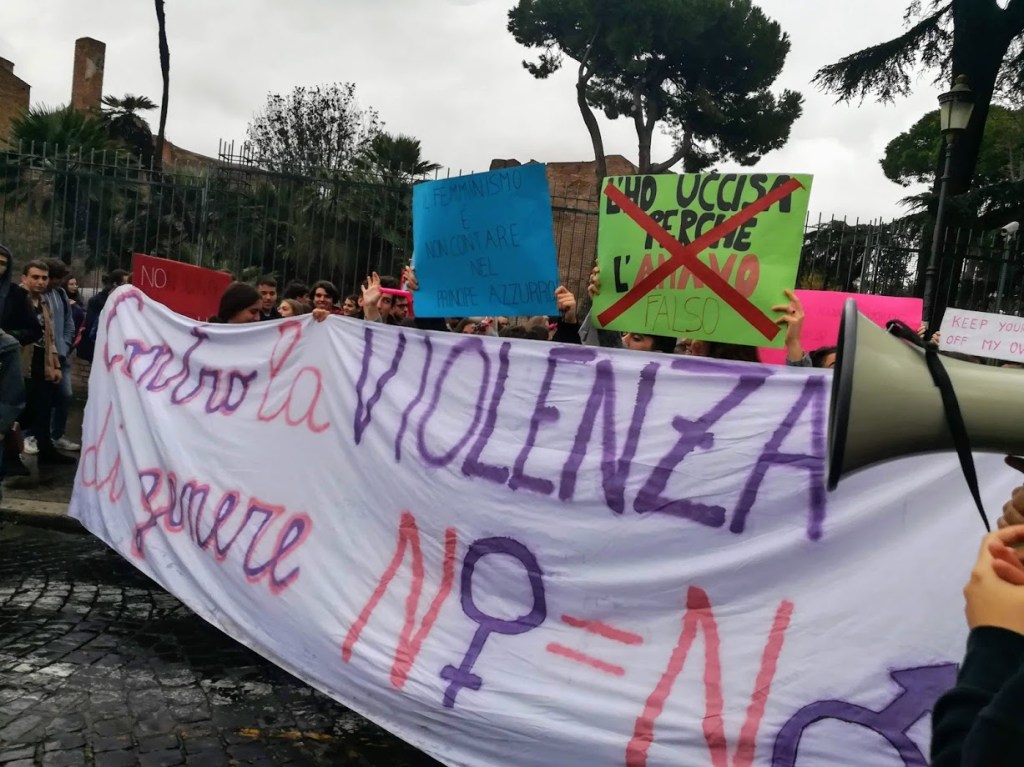
March of Non Una Di Meno (Not One Woman Less) on the occasion of the International Day for the Elimination of Violence Against Women (November 2018). © Camelia.boban / Creative Commons Attribution 4.0 International License / Free for use / Wikimedia Commons
A young woman shares her achievements, such as a graduation, and the comments are filled with people questioning her degree, criticizing her thesis or making discriminatory remarks. From asking her to ‘make dinner’ to counting the number of babies she could have had instead of pursuing higher education, this has now become a regular event on social media. If you’re a woman and you are successful there is a chance you will get insulted, denigrated and the validity of your words will be questioned. How did we even get to this point?
The Switch in Political Discourse
The rise of gender-based hate speech and online harassment has become more evident in recent years, pushed by a shift in the political discourse and the rapid rise of populism. As Fratelli d’Italia, Rassemblement National, AfD and many other right-wing populist parties have been gathering more and more support, public speech has increasingly become hostile to women.
One of these parties’ main characteristic that has directly influenced the public’s attitude towards women is the cult of personality around their leaders, who are often portrayed as violent and ruthless strongmen. This feature is also present in female leaders, such as Marine Le Pen, who has been compared to historical male French figures like Napoleon and Charles de Gaulle with her willingness to protect French interests against multinational corporations, American influence, and anything else that stands in her way. Ironically, she has also been praised for being a non-“vulgar feminist” distancing herself from the “violent masculine left-wing feminist”. She is, thus, identified as both tough “like a man” and beautiful, empathic and delicate like a woman. In doing so, however, she perpetrates this stereotypical narrative of women which undermines the female presence in any field.
A similar story can be observed in Italy. In 2022, after the parliamentary elections, Giorgia Meloni adopted a male-like image by requesting that she would be officially addressed with the masculine title “il Presidente”, in line with her party’s use of only the masculine term “fratelli”, brothers, despite the leader being a woman.
These attitudes, shared by both male and female right-wing politicians, directly shape public perceptions of women and how they are expected to behave in professional settings, further undermining their already fragile position, leadership, and authority.
Harassment on a Daily Basis
In a woman’s daily life, misogyny can often be present; small but common actions reflect a wider attitude that men hold towards women. Indeed, authority is usually considered a male feature, thus, particularly in mixed-gender contexts, women are interrupted when giving speeches, and are relegated to a supporter role. A similar example can be seen in what is known as the ‘respect gap’: the difference in how conventional markers of respect are used for male versus female professionals, for example, women are addressed as Dr. or Professor far less often than their male counterparts.
These small but impactful attitudes can eventually lead to catcalling, locker room banter, online harassment and hate speech against women. In fact, as social media now represents a vital part of our lives, misogyny also spreads easily across online content. In particular, comment sections of posts by women (whether famous or not) are often riddled with sexist and demeaning comments. One of the most popular cases involves Dr Ally Louks, an English academic who shared her PhD thesis on her X account in 2024. Her post went immediately viral and the comments were filled with harassment, hate speech and death threats. All of this despite her not even being a public figure. Most misogynistic criticism reflected the traditional gender roles. Among some comment examples we see:
“Women would rather spend years pursuing stupid degrees that won’t fulfill them over a family that actually will…”
“Wow you wrote something worthless that nobody is ever going to read instead of starting a family. Here’s a sticker.”
Other accounts have questioned her title “Dr.”, since she is not a doctor of medicine, which is the most common use for this term. This attitude not only demonizes women’s role in academia, but also the academia itself, by considering her (admittedly, rather niche) field of olfactory ethics as less worthy of respect and professionalism.
“I’m not calling you doctor… Not for that field”
In other comments her work was defined as “pretentious and too woke”. The situation escalated up to the point that a man found her personal email address and threatened her with gang rape. Another similar and more recent event involved Dr Juliet Turner in November 2025, when she shared her graduation. The Doctor was immediately harassed with derogatory and misogynist comments, as she shared on X.
“‘Just look at the degree on that chick’ ~ No man ever”
The First Step in Harassment

Rape Culture Pyramid. Original by Jamie Charlton & C. Cowan (11th Principle: Consent). Licensed under CC BY-NC-SA.
As seen from the pyramid developed by 11thPrincipleConsent, there is a link between sexist attitudes, rape jokes and general misogynist speech and revenge porn and rape. This link is fundamental in understanding why the worst crimes happen and why talking about simple discriminatory comments on X is vital to tackle the wider issues of violence against women. Already “sexist humor communicates an implicit normative standard that… one can treat sex discrimination in a less serious, more light-hearted manner”, as Romero-Sánchez et al. state in their research.
Thus, jokes discriminating against women on the basis of their sex increases the tolerance of sexist events, and men who show these misogynistic attitudes can “feel free to express their prejudice without fear of social reprisal”. This, then, takes us to politicians portraying themselves as more stereotypically masculine figures, which fosters a wider endorsement at commenting on women’s lives in a more discriminatory way. The situation is worsened by the identity that female far-right politicians adopt to please this political masculinity and their male counterparts. In addition, patriarchal attitudes nurture victim blaming and diminishing women’s credibility even in severe cases like rape. These behaviours and patterns exemplify this culture and trivialise violence against women. They also sustain the inadequate criminalisation of rape and feed into the most extreme expression of gendered violence: Femicide.
As seen in real comments, harassment against women does not only show through major crimes, it is often present in our lives. This discriminatory attitude has become even more rampant in recent years, and nothing suggests that this trend is likely to reverse in the near future. This is precisely why it is now more important than ever to engage in understanding the issues, identifying misogynistic attitudes, and calling them out like many young female graduates did with the case of Dr Juliet Turner. Additionally, promoting sexual education that values the respect of any person is key to ensuring future generations reject this misogyny rather than inherit it. Of course, the path forward is difficult and full of obstacles, and setbacks are inevitable. But they cannot be an excuse to halt the fight against harassment, and ultimately, violence against women. It can all begin with one simple comment on social media, like asking this author what she is going to cook for dinner.
Disclaimer: The views and opinions expressed in this article are those of the author(s) and do not necessarily reflect the official position of Neo Institute Europa. The Neo Institute publishes contributions to foster informed public debate. While articles may be reviewed and edited, the author(s) remain solely responsible for the claims, interpretations and conclusions expressed. This content is provided for informational purposes. The Neo Institute Europa shall not be liable for any loss or damage arising from reliance on this article.
 Neo Institute Europa