
Europe’s Place in the Multipolar Quantum Order
Author: Adrian Diez Cuadrado
Editor: Oscar Diez (Head of Sector Quantum Computing at the European Commission)
06/10/2025
5 minutes
“A multipolar quantum order should not be composed of an increasingly hostile relationship between the US and China, but should be brokered with the help of Europe to benefit all of humanity”
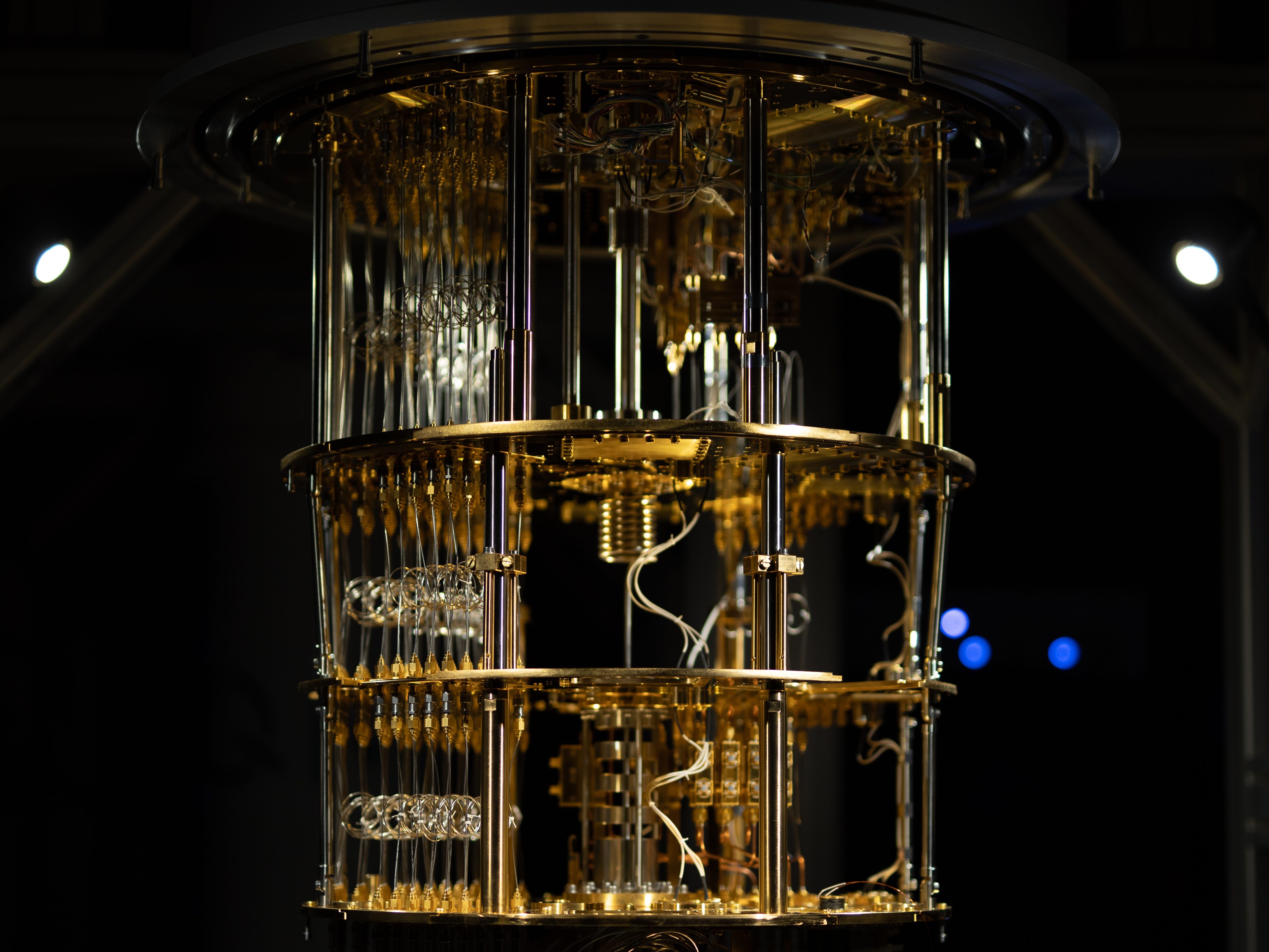
IQM Quantum Computer Espoo Finland (August 2020). © Ragsxl / Creative Commons Attribution 4.0 International License / Free for use / Wikimedia Commons
The future will be Quantum
Whether we like it or not, many classical computing systems are starting to reach their limits. Quantum computing offers a surpassing of barriers and a new technological gateway for humanity to explore. Where classic computer information or ‘bits’ exist as 1’s or 0’s, quantum ‘qubits’ can be either, or both simultaneously. This can potentially lead to quantum computers solving certain tasks in minutes or seconds that would take the world’s fastest supercomputers thousands or even millions of years. As classical computers can simulate no more than 50 entangled qubits efficiently, reaching a quantum advantage seems to be a matter of when, not if.
So how is this future technology actually useful for everyday Europeans and why should we invest so much money in advancing its research and development? Firstly, quantum technology and AI research are mutually beneficial to each other: Quantum algorithms can speed up AI tasks such as pattern recognition and learning. Whereas AI techniques can improve on current quantum algorithm designs and quantum error correction. These computers can advance research in drug discovery, break classical encryption mechanisms and create new quantum-safe cryptographic systems. They can also provide highly accurate and real-time climate predictions, model complex financial systems, simulate economic scenarios under uncertainty and optimise investment portfolios. Finally, they can help city planners analyse transportation networks, accelerate the discovery of new materials, improve disease detection and propel the space industry into new heights. Europe’s early wins will come not only from computing but also from quantum sensing and secure communications. It is clear that the potential beneficial uses for quantum technologies are far and wide.
So why has this technology with such great potential not been universally implemented yet? The reason is that this new technology still has its challenges as it needs a significant amount of further research, development and time. These computers have a reputation for being unreliable. For instance, for these quantum computers to surpass currently widely available supercomputers, their error rates must be dramatically lowered so that complex calculations can be performed well.
Despite these challenges, progress is accelerating worldwide, and Europe cannot afford to be left behind, as quantum is progressing much faster than AI research did in its early days. Quantum computing is not a distant dream, it is a strategic necessity in today’s multipolar world order.
Europe needs to be at the forefront of this new technological revolution
The potential benefits for Europe of this new technology are too great to be ignored. From furthering Europe’s already great research capabilities in biotechnology development as well as automotive and aerospace production. By 2040 this sector is expected to exceed a global value of 155 billion EUR and create thousands of skilled jobs. Europe is preparing to place itself at the forefront of Quantum development with the European strategy and Quantum Act.
The EU focuses on five areas that will promote Quantum Computing: Research and innovation, quantum infrastructures, ecosystem strengthening, space and dual-use technologies and quantum skills. With the European HIgh Performance Computing Joint Undertaking (EuroHPC JU), the European Commission is preparing to build exploratory quantum computers. Czechia, Germany, Spain, France, Italy and Poland will all contribute half of the cost with the EU contributing the other half to develop quantum computing technology in their countries. This investment will total 100 million EUR. The first European quantum computer was inaugurated in Poznan, Poland in June 2025, with the second computer being recently inaugurated in Ostrava, Czechia.
Nevertheless, the EU is struggling to translate its innovation capabilities into real market opportunities. Adding to this there are further problems with cohesion of policy and fragmentation amongst some member states. Although the EU leads the world in scientific publications on quantum technology, it struggles in keeping innovations and commercialisation within its sphere of influence. As much of this talent and innovation created within the EU seeks further funding opportunities outside of the union. Europe has often been a key player in early stage research for technologies, however often lacks behind when funding and commercialisation start to set in motion these new technologies. Therefore, the EU should incentivise its research advantage with greater funding opportunities and demand-side policy initiatives with measurable targets, to rival both the US and China in the quantum realm.
The multipolar quantum order
As with other key technologies, there is a global race to utilise this technology to compete with other powers. The US, China and the EU are all engaged in a high-stakes marathon to further their strategic competencies this technology can provide. Since it will require great investment and development, this is not a case of a quick sprint that will last several years but a decades-long marathon to utilise quantum’s many benefits.

European Commission (2025). Global Public Investment in Quantum Technologies.
China already sees quantum technology as vital to compete in this multipolar world. It has increased government spending up to 15 billion USD. Beijing has realised that whoever has an advantage in quantum technology will have increased capabilities in military cryptology and communication. However, since most of the funding comes from government subsidies, China is said to be lacking research commercialisation and private funding compared to the US.
The US is home to some of the largest private companies engaging with quantum technology. It provides the technology with massive private-sector investment, alongside help from the government. Google has developed a new quantum chip named Willow. It has performed computations in around the same time it would take to read this article that would take a supercomputer 10 septillion years, a length of time that exceeds the age of the known universe. Microsoft has reportedly found a way to combine the strengths of classical computing infrastructure with those of quantum technologies.
Other actors included in the multipolar quantum race include; the UK, which started early in 2014 on quantum investment, Canada with its National Quantum Strategy and Japan. As strategic partners in this multipolar world, the EU and Japan have found several industries to collaborate and mutually benefit each other in. Both parties have promised to enhance cooperation in quantum science. The Q-NEKO project has been selected to support this collaboration with 4 million EUR in funding bringing together 16 European and Japanese partners to advance hardware, software, and hybrid high-performance computing-quantum computing environments. The applications of this technology will cover the fields of biomedical and material science to tsunami and climate modelling.
To sustain its leadership in research publishing and successfully translate this strength into technological infrastructure and funding, the EU must leverage collaboration opportunities with its network of allied countries.
Tomorrow’s outlooks and promises
The heaps of benefits a quantum future will provide Europe and humanity as a whole will be substantial. From better predictions of potentially dangerous weather patterns to new drug discoveries that would not be possible with today’s fastest supercomputers.
However, as with many technologies, the possibility of negative impact use of quantum technologies must also be considered. Cybersecurity experts are afraid that a quantum computer will be able to break into existing cryptographic codes, enabling criminals and wrongdoers access to protected information. Moreover, there will be an increased gap between developed/developing countries and organisations with access to state-of-the-art quantum technology. As those developing will struggle to keep up with security, will be at risk and vulnerable to espionage and corruption. Finally, governments will be able to process vast amounts of data and gain access to real-time decrypting abilities. This will potentially allow these governments (or large tech companies) to overextend their authority on their citizens by deepening their invasion into the private lives of people, especially so in totalitarian regimes. Europe as a whole, with the EU at the forefront, should consider the potential for this misuse of this growing technology.
Nevertheless, this should not incentivise a detachment from the positive benefits quantum technologies will bring. Europe should use its scientific expertise, further the development of its hardware and promote investment to keep valuable individuals and organisations within its sphere of influence.
People will make Europe’s quantum future: By expanding master’s level specialisations, micro-credentials for engineers and technicians and short courses for public buyers and regulators, expanding people’s knowledge will yield greater results. Adding to this, easier visas and mobility schemes could attract great global minds, as well as promoting the upskilling of Europe’s workforce.
These recommendations can allow Europe to be at the forefront of the quantum future as well as aim to negate and minimise its potential negative impacts. After all, a multipolar quantum order should not be composed of an increasingly hostile relationship between the US and China, but should be brokered with the help of Europe to benefit all of humanity, now and well into the future.
Disclaimer: The views and opinions expressed in this article are those of the author(s) and do not necessarily reflect the official position of Neo Institute Europa. The Neo Institute publishes contributions to foster informed public debate. While articles may be reviewed and edited, the author(s) remain solely responsible for the claims, interpretations and conclusions expressed. This content is provided for informational purposes. The Neo Institute Europa shall not be liable for any loss or damage arising from reliance on this article.

